
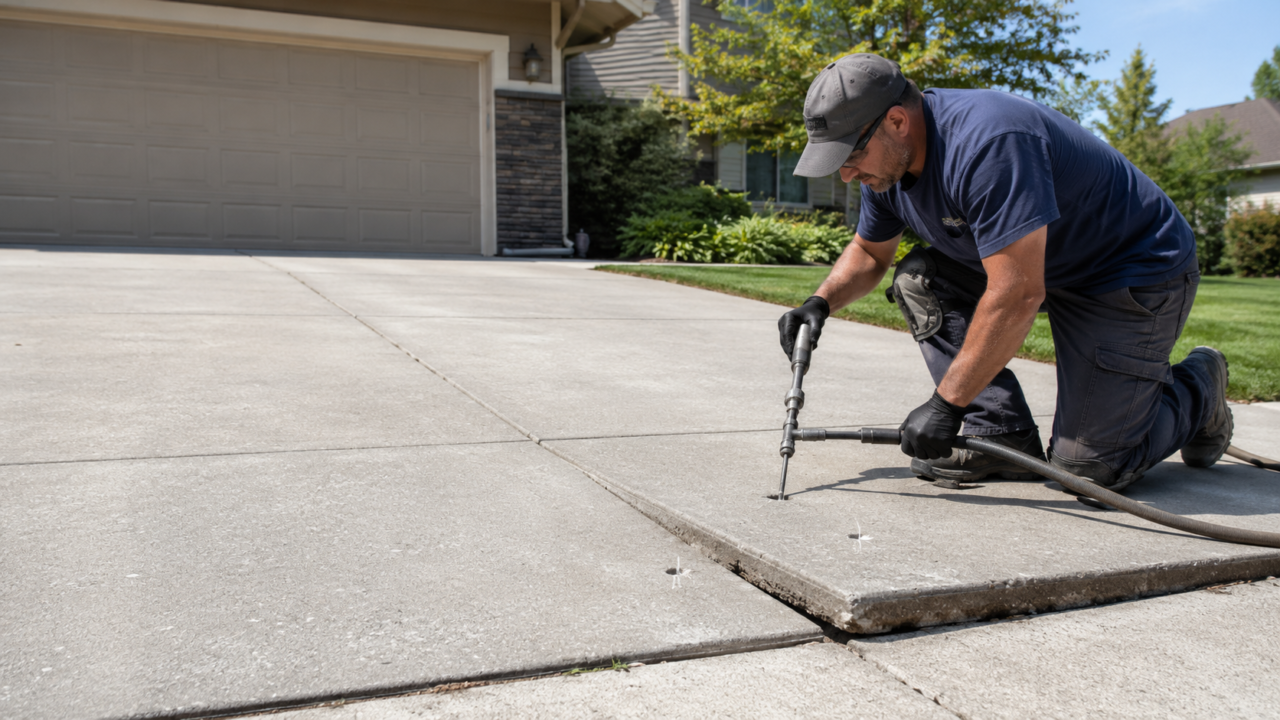
A sinking driveway is a common problem, especially near the garage door, faced by many homeowners. This issue can affect not only the driveway itself but also the house and its foundation. It often starts as a small low spot, a hairline crack, or a slight dip where water collects after it rains. Over time, that uneven area can become more noticeable. Concrete slabs may tilt, asphalt may settle into ruts, cracks may spread, and gaps may appear where the driveway meets the garage floor, sidewalk, curb, or foundation.
Sunken spots in the driveway can act as collection points for rain and snow, which may cause icing in winter and further erode the soil underneath. Additionally, uneven surfaces between the driveway and the garage or sidewalk create tripping hazards that can pose safety risks for residents and visitors.
Many homeowners mistakenly believe that replacement is the only option for a sinking driveway. However, concrete leveling is often the best solution, as it addresses the root cause of the problem and helps prevent water damage and foundation problems. Sinking can also extend beyond the driveway, potentially causing damage to the home’s foundation, attached porches, or nearby patios. The best repair method depends on the driveway material, the cause of the settlement, the severity of the damage, and whether the base beneath the surface is still stable.
What Does a Sinking Driveway Look Like?
A sinking driveway does not always fail all at once. In many cases, it develops gradually. Common visual signs include:
- Uneven concrete slabs that sit lower than nearby sections
- Asphalt depressions, dips, or ruts
- A small dip or depression that may be the first sign of settlement
- Cracks that widen or spread over time
- Water pooling in low spots after rain or snowmelt
- A visible gap between the driveway and garage slab
- Edges that crumble or break away
- Vehicles scraping as they enter or exit the driveway
- Sections that slope toward the home, garage, or foundation
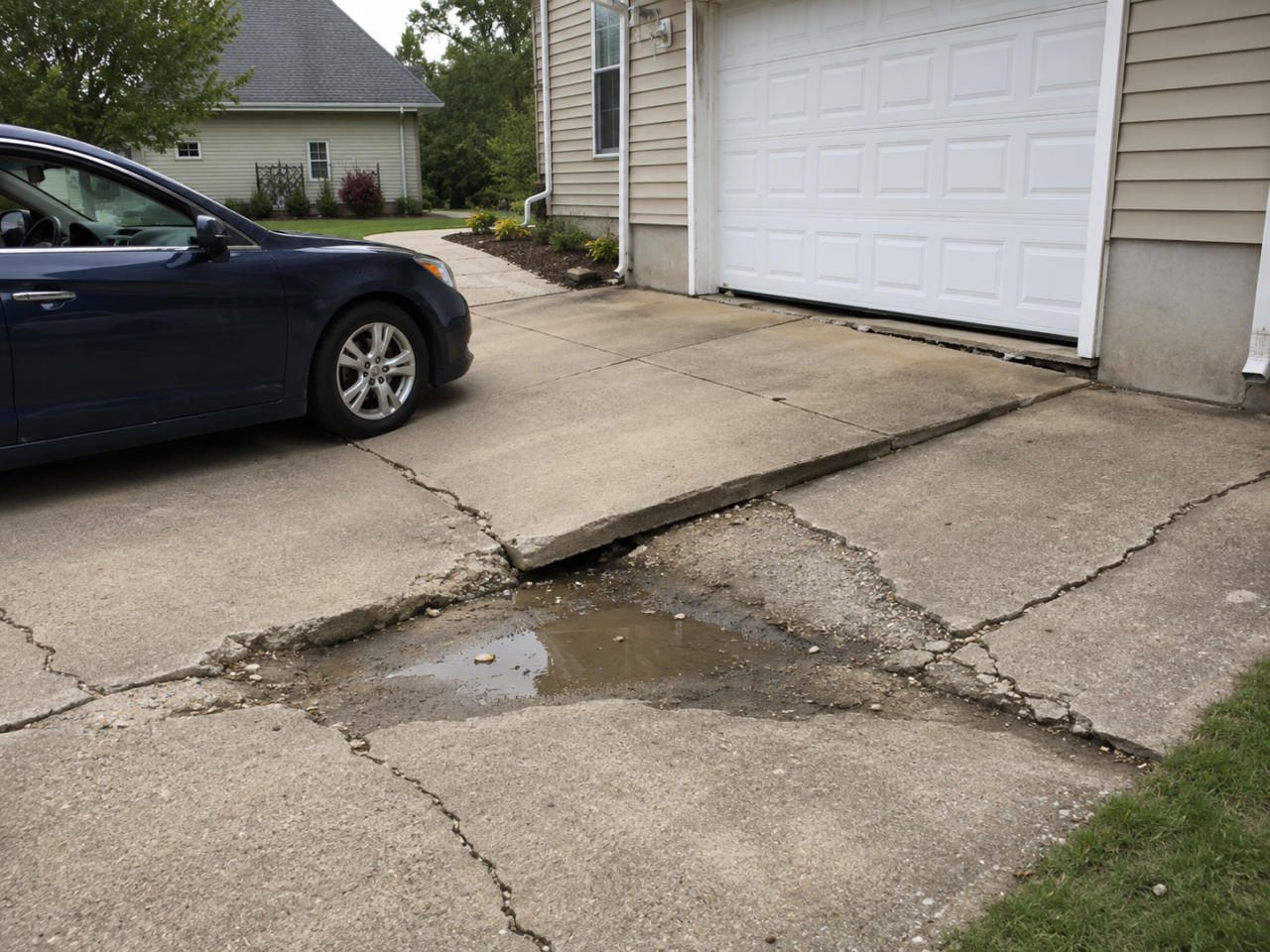
A small dip is often the first sign of a larger problem and should not be ignored. A slight dip may not seem urgent at first, but standing water and unsupported pavement can accelerate damage. The earlier you identify the cause, the easier it is to choose a cost-effective repair.
Common Causes of Driveway Sinking
Before deciding how to fix a sinking driveway, it is important to understand why the driveway settled in the first place. Repeated pressure from vehicles parking in the same spot can compress the soil underneath, leading to instability and eventual sinking. Repairing the surface without correcting the underlying issue with the soil underneath can lead to repeated sinking.
Poor Soil Compaction
Driveways need a stable, compacted base. Loose fill, or inadequately compacted soil, is a common cause of poor soil compaction leading to driveway sinking. If the soil or aggregate beneath the driveway was not properly compacted during installation, it can compress over time. This creates voids under the surface and causes concrete or asphalt to sink.
Soil Erosion
Water is one of the most common causes of driveway sinking. Runoff from gutters, downspouts, irrigation, rain, or snowmelt can wash soil away from beneath the driveway. Once the surface loses support, it may crack, tilt, or settle.
Drainage Problems
A driveway that does not drain properly can hold water along the surface, edges, or base. Poor drainage can weaken the subgrade, especially if water repeatedly flows under the driveway or collects near the garage.
Freeze-Thaw Cycles
In cold climates, water can seep into cracks or porous base material, freeze, expand, and then thaw. This repeated movement can shift the driveway surface and weaken the supporting material underneath.
Tree Roots
Tree roots can push against concrete or asphalt, lift sections of the driveway, or disturb the soil beneath the surface. In some cases, decaying roots can also leave empty spaces that cause sinking later.
Heavy Vehicle Loads
Driveways are typically designed for passenger vehicles, not constant heavy loads. RVs, trailers, work trucks, dumpsters, and delivery vehicles can stress weak areas, especially if the base is already compromised.
Aging Base Material
Even a well-installed driveway can settle as it ages. Base materials may shift, compact further, or erode over many years. Older driveways are more likely to show a combination of cracks, low spots, and edge deterioration.
Improper Installation
A driveway may sink prematurely if it was installed with an inadequate base depth, poor grading, insufficient drainage, weak materials, or improper curing in the case of concrete.
Warning Signs of a Sinking Driveway
Homeowners should look for early warning signs before the damage becomes widespread. The most common signs of driveway sinking include:
- Low spots: Areas that sit below the surrounding surface.
- Spreading cracks: Cracks that widen, branch, or continue across multiple slabs.
- Water pooling: Standing water that remains after rain or snowmelt.
- Crumbling edges: Broken edges where soil has washed away or support has weakened.
- Scraping vehicles: Cars bottoming out when entering the garage or driveway.
- Sloping toward the home: A driveway that directs water toward the garage, foundation, or basement.
- Gaps near the garage: Separation between the driveway and garage floor.
- Uneven transitions: Raised or sunken sections near sidewalks, curbs, patios, or walkways.
These signs help determine whether the problem is minor surface settlement or a deeper base failure.
Best Repair Methods for a Sinking Concrete Driveway
Concrete driveways are usually made of individual slabs or sections. When one or more slabs sink, concrete leveling is often the best solution because it addresses the root cause of the problem—underlying support or soil issues—rather than just the surface. This process can often be completed in just a day, allowing the driveway to be ready for use shortly after the repair. The repair method ultimately depends on the amount of settlement, slab condition, soil stability, and drainage.
Concrete Lifting or Slabjacking
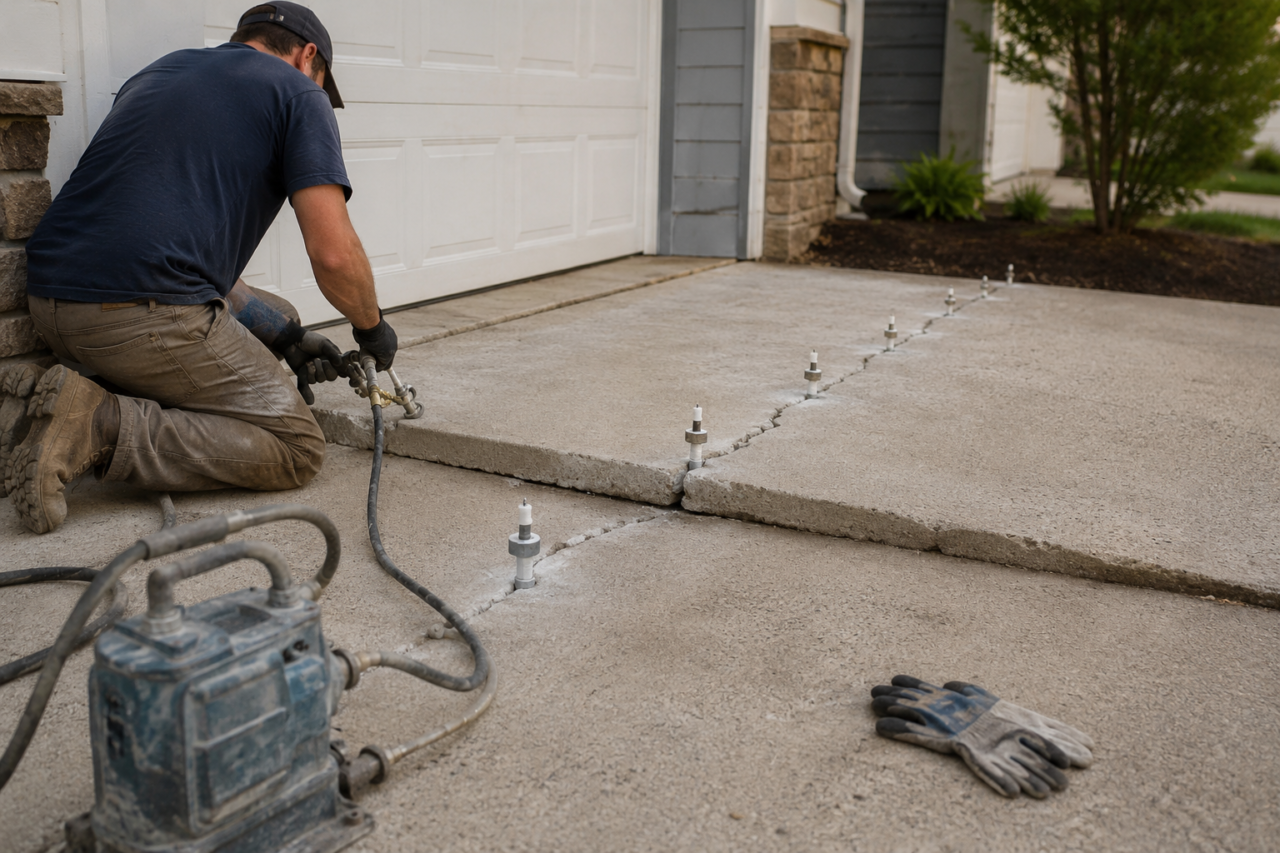
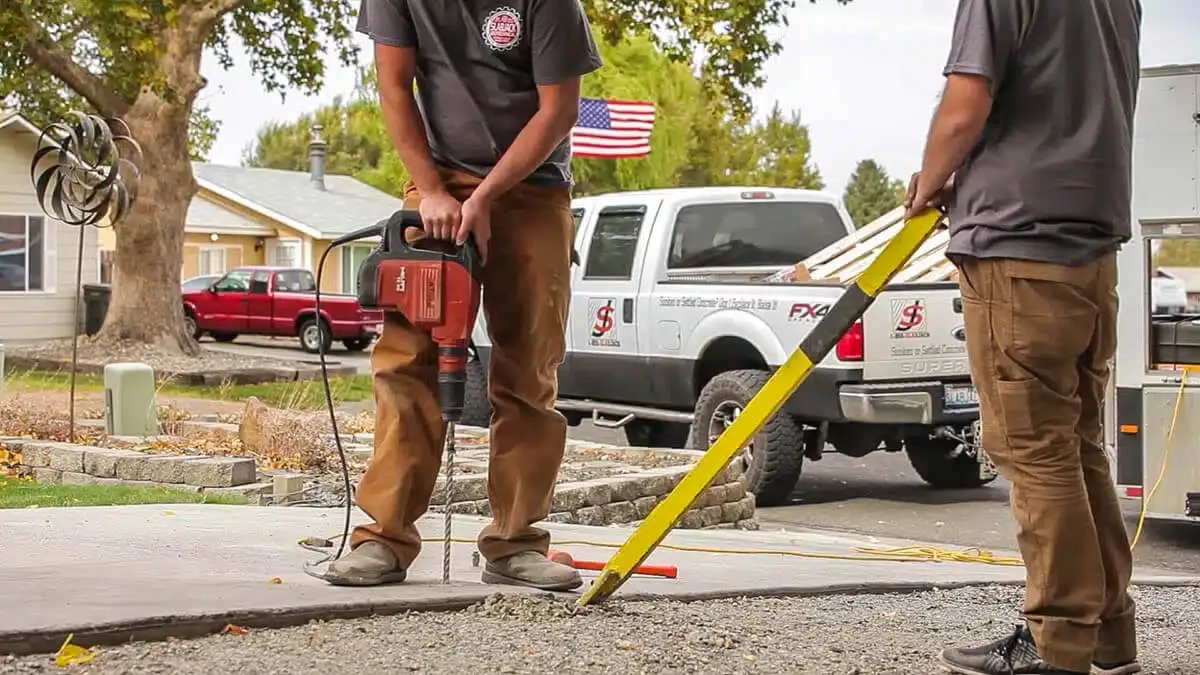
Concrete lifting, often called slabjacking, is a repair method used to raise sunken concrete slabs back toward their original position. Small holes are drilled into the concrete, and material is injected beneath the slab to fill voids and lift the surface.
This method is often appropriate when:
- The concrete slab is mostly intact
- The surface has settled but is not severely broken
- Voids exist beneath the slab
- The driveway has uneven sections or trip hazards
- The homeowner wants to avoid full replacement
Slabjacking can be a practical option for many sinking driveway problems because it addresses the lack of support beneath the concrete rather than simply covering the surface.
Polyurethane Foam Injection
Polyurethane foam injection uses expanding structural foam to lift and stabilize sunken concrete. The geo-polymer foamis injected through small holes, expands beneath the slab, fills voids, and hardens quickly.
This method is often a strong choice when:
- Fast cure time is important
- The driveway needs lightweight support
- Voids under the slab need to be filled
- Precision lifting is needed
- Water resistance is a priority
Polyurethane foam is commonly used for concrete lifting because it is lightweight, minimally invasive, and effective for stabilizing settlement caused by voids or weak support beneath the slab.
Mudjacking
Mudjacking is another concrete raising method that uses a cement-based slurry to lift sunken concrete. The slurry is pumped beneath the slab to fill voids and raise the surface.
Mudjacking may be appropriate when:
- The slab is thick and structurally sound
- The soil can support the added weight of the slurry
- The settlement is moderate
- Budget is a major concern
However, mudjacking material is heavier than polyurethane foam. If the soil beneath the driveway is weak or prone to erosion, the added weight may not be ideal.
Concrete Resurfacing
Concrete resurfacing involves applying a new surface layer over existing concrete. It can improve appearance and correct minor surface imperfections, but it does not fix major sinking or base failure.
Resurfacing may be appropriate when:
- The driveway is mostly level
- Cracks are shallow and stable
- The damage is cosmetic
- The slab underneath is structurally sound
Resurfacing is not the right solution if the driveway is actively sinking, has large voids beneath it, or slopes toward the home due to settlement.
Partial Slab Replacement
Partial slab replacement involves removing and replacing only the damaged or sunken section of a concrete driveway. This can be a good option when one slab is badly cracked, broken, or too deteriorated to lift.
Partial replacement may be appropriate when:
- One or two slabs are severely damaged
- The rest of the driveway is in good condition
- The base can be rebuilt under the replaced section
- The cracks are too extensive for lifting or resurfacing
This method allows homeowners to fix isolated damage without replacing the entire driveway.
Full Concrete Driveway Replacement
Full replacement may be necessary when the concrete driveway has widespread cracking, severe settlement, major drainage problems, or extensive base failure. While replacement costs more than lifting or partial repair, it may be the better long-term choice if the existing driveway can no longer be stabilized.
Full replacement is usually appropriate when:
- Most slabs are cracked, tilted, or sinking
- The base has failed across a large area
- The driveway has repeated settlement after prior repairs
- Drainage must be redesigned
- The concrete is near the end of its service life
Best Repair Methods for a Sinking Asphalt Driveway
Asphalt driveways behave differently from concrete. Instead of individual slabs, asphalt is a continuous flexible surface. Repairs often focus on restoring low spots, fixing drainage, and rebuilding weak base areas.
Patching Low Spots
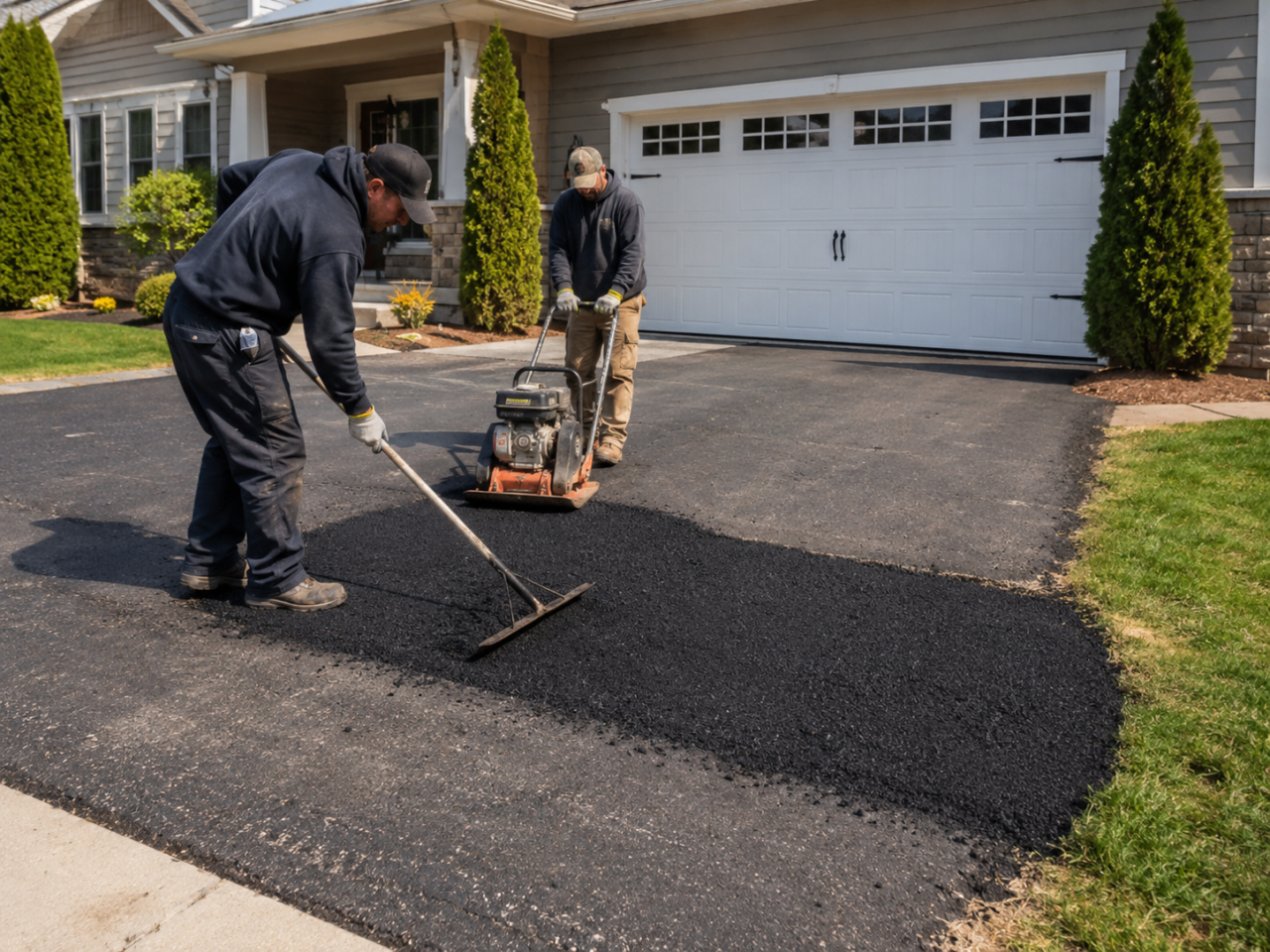
Patching can be used for small depressions or isolated low areas in an asphalt driveway. The damaged area is cleaned, filled, compacted, and blended with the surrounding surface.
Patching may be appropriate when:
- The low spot is small
- The base is still stable
- The asphalt is not severely cracked
- Water pooling is minor
- The homeowner needs a budget-friendly repair
Patching is not ideal for widespread driveway sinking or areas with serious base failure.
Infrared Asphalt Repair
Infrared asphalt repair uses heat to soften existing asphalt so it can be reworked, blended with new material, and compacted. This can create a smoother repair than a basic patch.
Infrared repair may be appropriate when:
- The asphalt has localized sinking or surface damage
- The surrounding pavement is in decent condition
- A seamless-looking repair is preferred
- The damage is not caused by deep base failure
This method works best for surface-level or moderate asphalt repairs, not major structural settlement.
Asphalt Overlay
An asphalt overlay adds a new layer of asphalt over the existing driveway. It can improve appearance, smooth uneven areas, and extend the life of the driveway.
An overlay may be appropriate when:
- The existing asphalt is worn but mostly stable
- Cracks are not severe or widespread
- The driveway has minor unevenness
- The base is still structurally sound
An overlay should not be used as a cover-up for active sinking, poor drainage, or a failing base. If the underlying problem remains, cracks and low spots can return through the new layer.
Removing and Replacing Damaged Sections
For deeper asphalt damage, the affected section may need to be cut out, removed, and replaced. This allows the contractor to rebuild the base beneath the damaged area before installing new asphalt.
Section replacement may be appropriate when:
- A specific area has sunk badly
- The asphalt is cracked, broken, or unstable
- The base beneath that section has failed
- Drainage or erosion has damaged a localized area
This is often a better solution than patching when the problem extends below the surface.
Regrading and Rebuilding the Base
If an asphalt driveway sinks because of poor drainage, erosion, or weak base material, regrading and base reconstruction may be necessary. This involves correcting the slope, rebuilding the aggregate base, and then replacing the asphalt surface.
This method may be appropriate when:
- Water flows toward the garage or foundation
- The driveway has widespread low areas
- Soil washout is visible around the edges
- Prior patches have failed
- The surface lacks proper slope
Regrading is especially important when the driveway directs water toward the home.
Full Asphalt Replacement
Full asphalt replacement is usually the best option when the driveway is badly cracked, uneven, rutted, or structurally worn out. It allows the old asphalt to be removed, the base to be corrected, and a new surface to be installed.
Full replacement may be appropriate when:
- The asphalt is old and brittle
- Cracks cover most of the driveway
- Multiple areas are sinking
- The base has failed
- Drainage problems require a complete redesign
- Repairs would only provide a short-term fix
How to Choose the Right Repair Method for Driveway Sinking
Choosing the right repair method depends on more than the visible damage. A proper decision should consider the material, the cause, the severity, and the long-term performance you expect.
1. Driveway Material
Concrete and asphalt require different repair strategies. A sinking concrete driveway may be a good candidate for slabjacking, polyurethane foam injection, or partial slab replacement. A sinking asphalt driveway may require patching, infrared repair, overlay, base rebuilding, or replacement.
2. Severity of the Sinking
Small dips may be repairable with localized methods. Larger settled areas, uneven slabs, or deep depressions usually require lifting, base repair, or section replacement.
3. Cause of Settlement
If the driveway is sinking because of soil erosion, drainage problems, or washout, the cause must be corrected. Otherwise, the repair may fail again.
4. Drainage Conditions
Drainage is one of the biggest factors in long-term driveway performance. If water pools on the surface or flows toward the garage, the repair should include grading, drainage correction, crack sealing, or erosion control.
5. Budget
Surface patches and minor repairs may cost less upfront, but they may not last if the base is unstable. Concrete lifting, foam injection, and section replacement can cost more initially but may provide a more durable result when used in the right situation.
6. Age of the Driveway
A newer driveway with one sunken section may be worth repairing. An older driveway with widespread cracking, crumbling edges, and repeated sinking may be better suited for replacement.
7. Expected Durability
If you plan to stay in the home long-term, choose a repair that addresses the cause, not just the appearance. A durable repair should stabilize the base, improve drainage, and reduce future settlement risk.
Repair or Replace: Which Makes More Sense?
Repair is often the better option when the driveway is mostly in good condition and the sinking is limited to one or a few areas. For concrete driveways, lifting or geo-polymer injection can raise sunken slabs without removing the entire surface. For asphalt driveways, localized patching or section replacement can work when the base failure is isolated.
Replacement makes more sense when the damage is widespread. If the driveway has extensive cracks, repeated sinking, major drainage problems, or base failure throughout the surface, repairs may only delay the inevitable. Replacement also becomes more practical when the driveway is near the end of its useful life or when the slope needs to be completely redesigned to move water away from the home.
As a general rule, repair is best for isolated settlement and structurally sound surfaces. Replacement is best for widespread deterioration, unstable base conditions, and recurring problems that cannot be solved with targeted repair.
What If Your Driveway Is Cracked and Sinking?
A driveway cracked and sinking needs careful evaluation because cracks can mean different things. Small, stable cracks may be sealed after the slab or asphalt is stabilized. Larger cracks, uneven cracks, or cracks that continue to spread may indicate deeper movement below the surface.
For concrete, a cracked and sinking slab may still be liftable if the slab remains mostly intact. If the concrete has broken into many pieces, partial slab replacement may be better. For asphalt, cracks combined with sinking often point to base weakness, drainage issues, or age-related deterioration. In that case, patching alone may not be enough.
The key is to determine whether the cracking is only surface-level or whether the driveway has lost structural support underneath.
When to Call a Professional
Some driveway problems are simple enough to monitor or patch, but others need professional evaluation. Call a concrete or asphalt repair professional if:
- The driveway slopes toward the home, garage, or foundation
- Water pools near the foundation
- The sinking keeps getting worse
- Cracks are spreading quickly
- A gap is forming near the garage slab
- The driveway has become a trip hazard
- You are not sure what is causing the settlement
- Previous repairs have failed
Professional contractors can identify whether the problem is caused by voids, erosion, weak soil, drainage issues, base failure, or improper installation. That diagnosis is essential before choosing the best repair method.
How to Prevent a Driveway From Sinking Again
After repairing a sinking driveway, prevention is the next priority. The goal is to keep water, soil movement, and heavy stress from damaging the driveway again.
Helpful prevention tips include:
- Improve drainage around the driveway
- Direct gutters and downspouts away from the driveway surface and edges
- Seal cracks early before water enters the base
- Avoid parking heavy vehicles on weak or unsupported areas
- Maintain proper grading so water flows away from the home
- Repair erosion along driveway edges
- Fill voids or washed-out areas quickly
- Keep expansion joints and control joints sealed when appropriate
- Address pooling water before it causes deeper base damage
- Monitor gaps near the garage, sidewalk, or curb
Small maintenance steps can significantly reduce the risk of future driveway sinking.
About Slabjack Geotechnical
Slabjack Geotechnical is a family-owned and operated full-service concrete repair company serving Washington and Northern Idaho. We help homeowners and property owners address concrete settlement, voids, sinking slabs, and related foundation settlement issues with practical repair solutions designed to restore stability and improve safety.
Our concrete repair services include slabjacking, also known as concrete raising, as well as pressure grouting, concrete grinding, void filling, concrete crack repair, and joint sealing repair. We also seal leaking culverts, large-diameter pipes, and concrete ditches.
For many sinking concrete driveway problems, our geo-polymer injection method offers a clean, effective way to lift settled concrete, fill voids, and stabilize the surface without replacing the entire driveway.
Ready to Fix Your Sinking Driveway? Contact Slabjack Geotechnical Today
Learning how to fix a sinking driveway starts with identifying the cause. A small low spot, uneven slab, or cracked section may be repairable without replacing the whole surface. Concrete driveways may benefit from slabjacking, polyurethane foam injection, geo-polymer injection, resurfacing, or partial slab replacement, depending on the condition of the concrete. Asphalt driveways may need patching, infrared repair, overlay, base rebuilding, or section replacement.
The most important step is to avoid treating only the surface when the real problem is underneath. If water, erosion, voids, or base failure caused the driveway sinking, those issues must be addressed to prevent future settlement.
If you have a sinking driveway in Washington or Northern Idaho, contact Slabjack Geotechnical today. Our team can evaluate the problem, explain your repair options, and provide a service quote for concrete lifting, void filling, crack repair, joint sealing, geo-polymer injection, and other concrete repair solutions that can help restore your driveway safely and efficiently.
FAQs
What causes a sinking driveway?
A sinking driveway is usually caused by poor soil compaction, soil erosion, drainage problems, freeze-thaw cycles, or a weakened base beneath the surface. When the material under the driveway shifts or washes away, the concrete or asphalt can settle, crack, or dip.
How do you fix a sinking driveway?
The best way to fix a sinking driveway depends on the material and the cause of settlement. Concrete driveways may be repaired with slabjacking, polyurethane foam injection, or partial slab replacement, while asphalt driveways may need patching, section replacement, base repair, or an overlay.
Can a sinking concrete driveway be lifted?
Yes, a sinking concrete driveway can often be lifted if the slabs are still mostly intact. Concrete lifting methods such as slabjacking or geo-polymer injection can raise settled slabs, fill voids, and restore a more even surface without replacing the whole driveway.
How much does it cost to fix a sinking driveway?
The cost to fix a sinking driveway depends on the driveway material, size of the settled area, repair method, access, and underlying cause. Concrete lifting or targeted asphalt repair is often less expensive than full driveway replacement, but a professional inspection is the best way to get an accurate quote.