
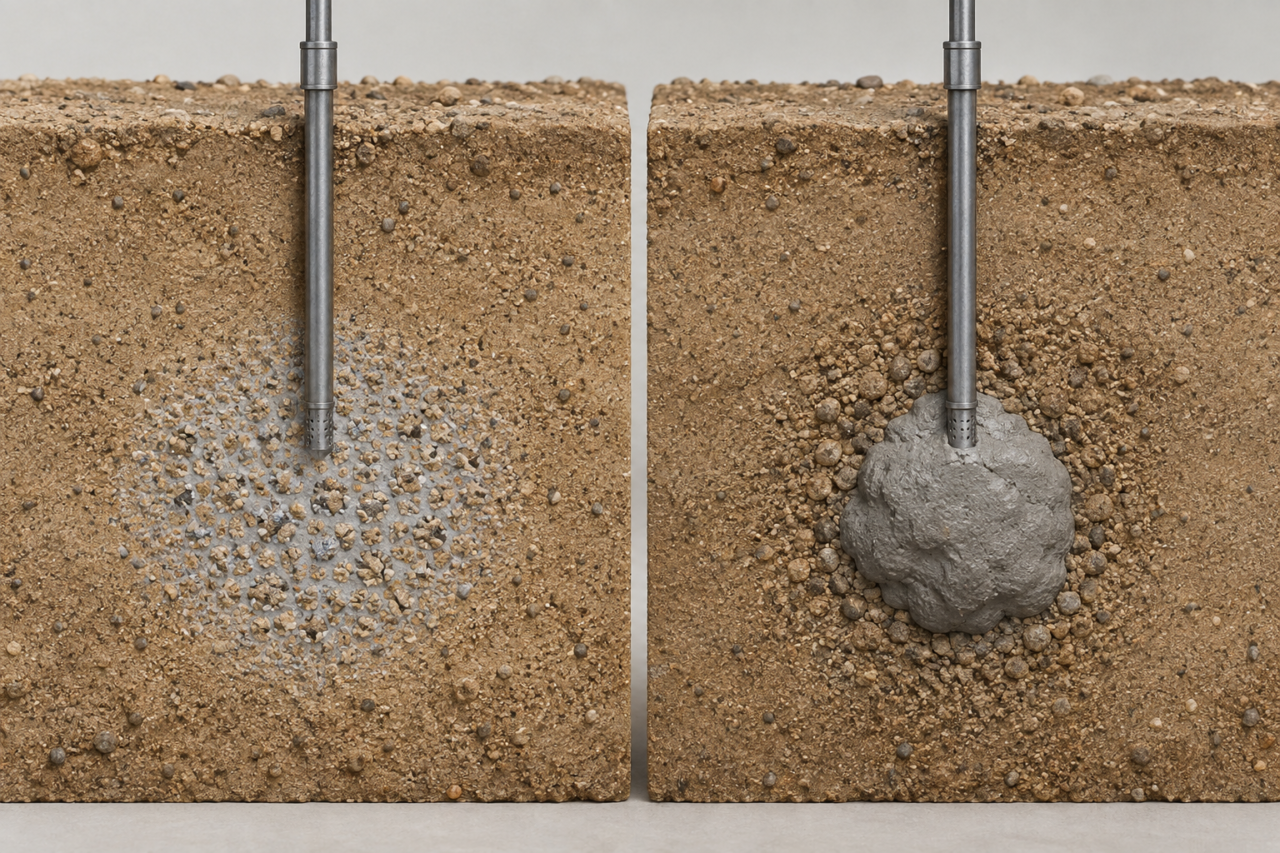
Unstable, loose, or poorly compacted soil can create serious problems beneath foundations, concrete slabs, roadways, retaining structures, and other improvements. When soil cannot adequately support the loads placed on it, property owners may experience settlement, cracking, void formation, or other forms of structural movement. Grouting techniques can address these subsurface conditions by strengthening, densifying, or otherwise improving the soil without requiring extensive excavation.
Two commonly used ground improvement techniques are permeation grouting and compaction grouting. Although both methods can improve soil stability and load-bearing performance, they achieve those results in very different ways. Understanding permeation grouting vs compaction grouting can help property owners, engineers, and contractors determine which technique is better suited to the soil conditions and objectives of a particular project.
What Is Permeation Grouting?
Permeation grouting is a soil stabilization technique that involves injecting a highly flowable, low-viscosity grout into the natural pore spaces between soil particles. Rather than deliberately moving or compacting the soil, the grout permeates through interconnected voids and then hardens within the soil matrix.
The Federal Highway Administration describes permeation grouting as a method intended to fill most of the natural pore spaces within a soil mass without significantly changing the soil’s original structure or volume. This distinguishes it from grouting methods that stabilize soil primarily through displacement.
Permeation grouting is particularly useful in granular soils where grout can move through the available pore spaces. Depending on the soil and project requirements, different cementitious or chemical grout formulations may be used. The U.S. Army Corps of Engineers notes that clean coarse sands and gravels may be permeated with Portland cement mixtures, while finer natural sands may require ultrafine cement or solution grouts.
How Does Permeation Grouting Work?
The basic permeation grouting process typically involves installing injection points within the area requiring treatment and introducing grout under carefully controlled pressures.
As the grout moves outward from each injection point, it fills interconnected spaces between soil grains. Once cured, the grout bonds with the surrounding soil and creates a stronger, more cohesive mass.
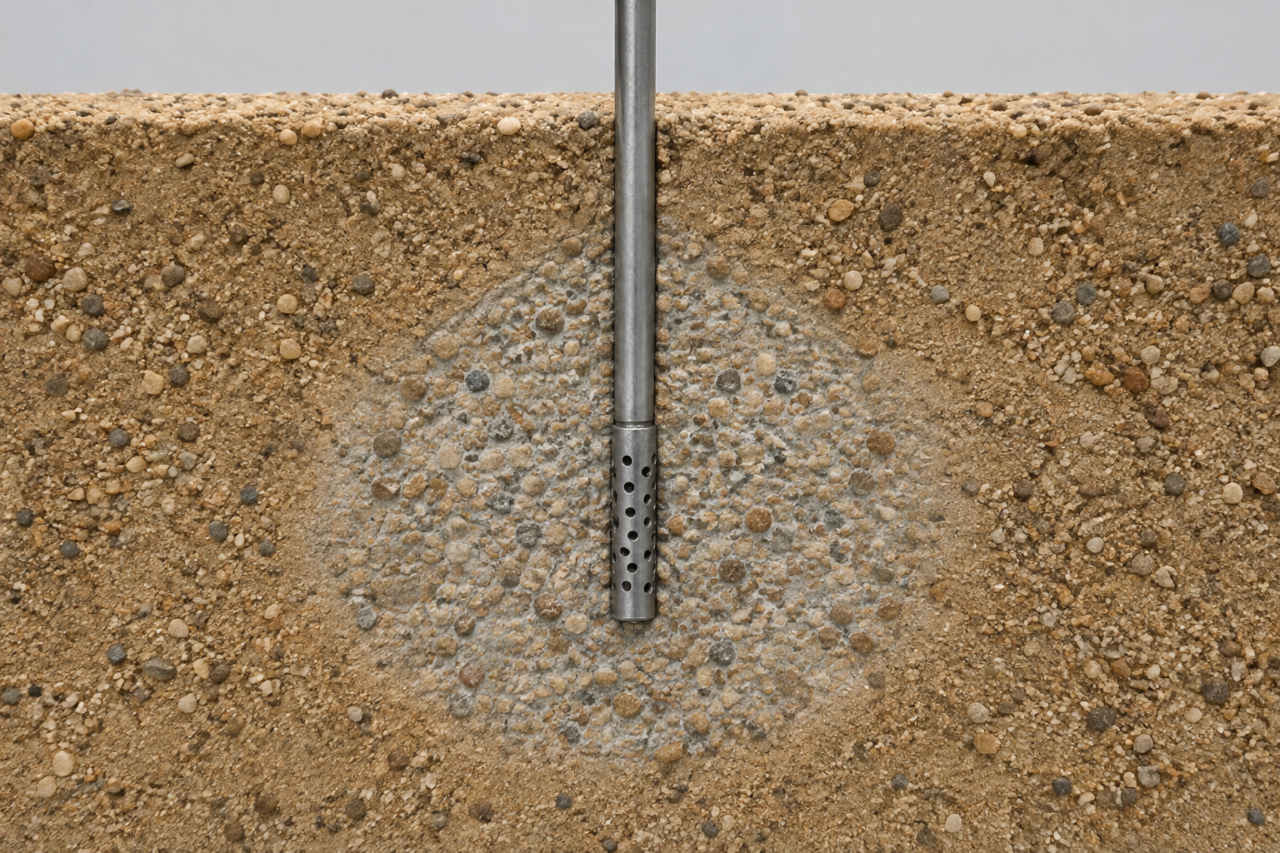
A typical process may include:
- Evaluating subsurface soil and groundwater conditions
- Determining appropriate treatment depths and injection locations
- Installing grout injection pipes or ports
- Selecting a grout with suitable viscosity and particle size
- Injecting grout at controlled pressures and flow rates
- Monitoring grout volume, pressure, and ground response
- Verifying that the desired soil improvement has been achieved
Because the objective is to permeate rather than displace the soil, controlling grout pressure is particularly important. Excessive pressure could cause soil movement or fracturing instead of allowing the material to move naturally through the pore structure.
What Is Compaction Grouting?
Compaction grouting takes a different approach to soil stabilization. Instead of using a fluid grout that penetrates the existing spaces between soil particles, compaction grouting uses a stiff, low-slump grout mixture that generally remains together as it is injected.
As grout is pumped into the ground, it forms an expanding mass that pushes against surrounding soil. This displacement compresses loose soil, reduces void space, and increases soil density.
The Federal Highway Administration defines compaction grouting as a process in which a thick, low-slump grout forms a bulb at the end of the injection pipe and displaces surrounding soil, thereby compacting and strengthening the soil between grout bulbs.
How Does Compaction Grouting Work?
Compaction grouting is typically performed progressively so the contractor can improve targeted soil layers while closely monitoring how the ground responds.
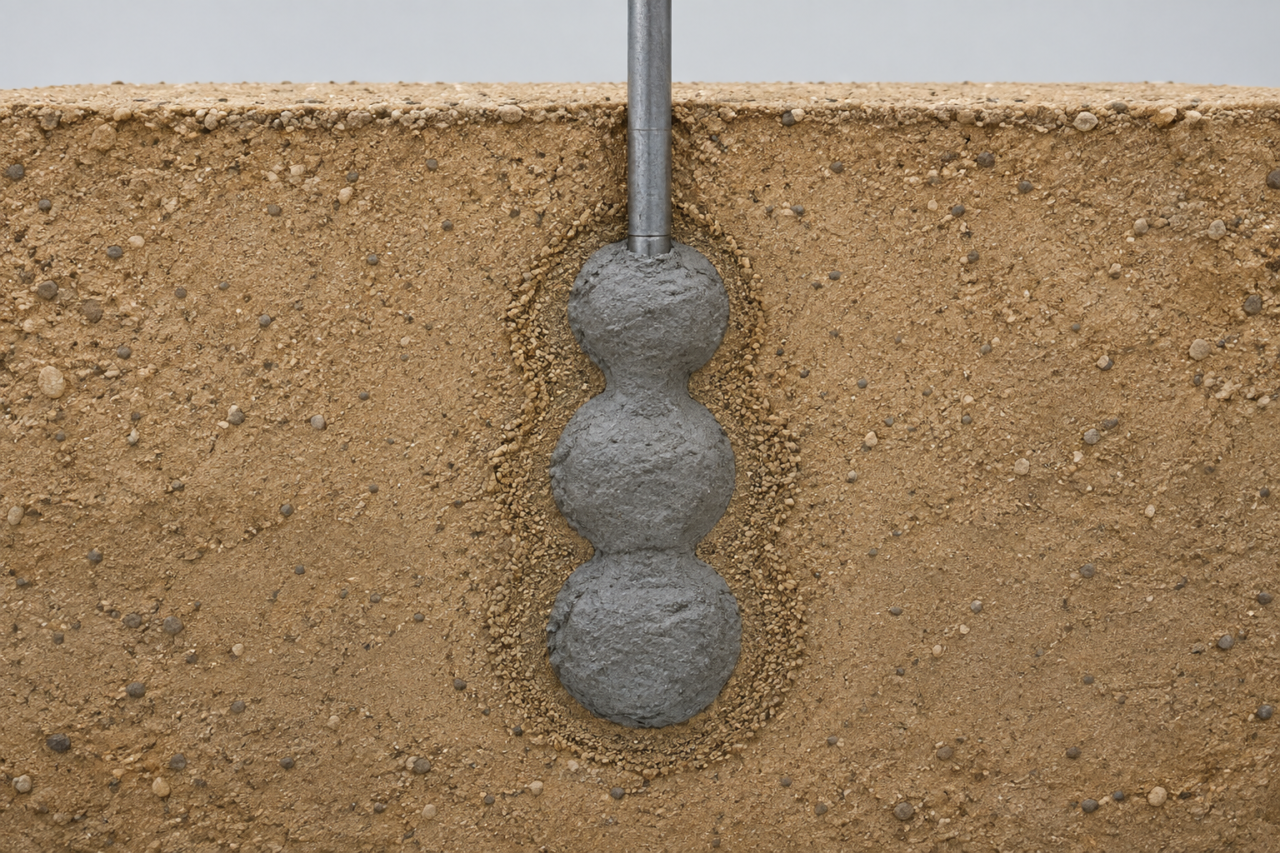
The general process may involve:
- Evaluating soil conditions and settlement patterns
- Establishing a planned pattern of injection locations
- Advancing casing or grout pipes to the required depth
- Injecting stiff, low-mobility grout
- Allowing the expanding grout mass to compact surrounding soil
- Raising the injection pipe incrementally to treat additional elevations
- Monitoring injection pressure, grout volume, and surface movement
Rather than filling individual soil pores, the grout essentially acts as a subsurface compaction tool.
Slabjack Geotechnical uses controlled compaction grouting procedures designed to densify and stabilize loose or unstable soils while monitoring grout quantities, pressure, and ground movement throughout the process.
Permeation Grouting vs Compaction Grouting: Key Differences
The primary difference between permeation grouting vs compaction grouting is how the grout interacts with the soil.
Permeation grouting moves through pore spaces without intentionally displacing the soil particles. Compaction grouting uses a much stiffer material to physically displace and densify the surrounding ground.
Here is a closer comparison:
| Factor | Permeation Grouting | Compaction Grouting |
| Primary mechanism | Fills pore spaces between soil particles | Displaces and compacts surrounding soil |
| Grout consistency | Low-viscosity and highly flowable | Stiff, thick, and low-slump |
| Effect on soil | Bonds soil particles without substantial displacement | Physically densifies loose soil |
| Primary purpose | Increase strength and/or reduce permeability | Increase density, bearing capacity, and stability |
| Common soil conditions | Permeable granular soils, particularly sands and gravels | Loose, weak, settled, or poorly compacted soils |
| Ground displacement | Generally minimal when properly performed | Intentional soil displacement |
| Water control | Can significantly reduce soil permeability | Not primarily intended as a seepage-control method |
| Settlement correction | Can strengthen soils vulnerable to movement | Frequently used to address or reduce settlement |
| Common applications | Excavation support, water control, underpinning, soil strengthening | Foundation stabilization, settlement mitigation, void treatment, soil densification |
Neither technique is automatically superior. The better method depends on what is causing the problem and what changes need to be made to the ground.
Differences in Grout Material
One of the most noticeable differences between the two methods is the consistency of the grout itself.
Permeation Grout
Permeation grout needs to be fluid enough to travel through the pore structure of the soil. Its ability to penetrate depends on several factors, including:
- Soil grain size
- Percentage and characteristics of fines
- Pore size
- Grout particle size
- Grout viscosity
- Injection pressure
- Groundwater conditions
Permeation grouting generally becomes more difficult as soils become less permeable. The U.S. Army Corps of Engineers notes that soil permeation is typically most practical in soils with relatively low fines content, although actual groutability varies according to soil gradation, the characteristics of the fines, and the grout being used.
Compaction Grout
Compaction grout is intentionally designed not to permeate readily through the soil. The stiff mixture is intended to remain relatively cohesive during injection so that it creates pressure against the surrounding soil.
This expanding grout mass can densify loose soils while also leaving behind hardened grout elements within the treated area. According to the U.S. Army Corps of Engineers, this process can increase soil bearing capacity and reduce the potential for settlement.
How Permeation Grouting Stabilizes Soil
Permeation grouting stabilizes the ground by filling the spaces between individual soil particles. Once that material cures, the previously loose granular material can become a much more cohesive mass.
This can produce several useful changes to the treated soil, including:
- Greater strength
- Increased stiffness
- Reduced permeability
- Improved resistance to erosion
- Better support for nearby foundations or excavations
- Reduced risk of soil loss caused by water movement
The technique can therefore serve both structural and seepage-control purposes. FHWA guidance distinguishes structural permeation grouting, which improves soil strength or rigidity, from waterproof grouting intended primarily to control the movement of water through the ground.
How Compaction Grouting Stabilizes Soil
Compaction grouting works through densification.
Loose soil contains spaces that allow particles to move closer together when external pressure is applied. By inserting a growing mass of stiff grout below the surface, a contractor can compress surrounding soil and reduce those spaces.
This process may help:
- Increase soil density
- Improve load-bearing capacity
- Reduce the potential for additional settlement
- Stabilize loose fills
- Strengthen soils beneath foundations and slabs
- Address localized weak zones
- Fill larger subsurface voids in appropriate applications
Because compaction grouting deliberately pushes outward against surrounding soil, contractors must carefully control the injection process. Excessive grout pressure or volume can potentially result in unwanted surface movement or structural lifting.
When Is Permeation Grouting Used?
Permeation grouting is often considered when the existing soil can accept grout through its pore structure and the project requires strengthening without substantial soil displacement.
Potential applications include:
Soil Strengthening
Granular soils that are relatively loose or weak can be transformed into a stronger cemented mass, improving their engineering characteristics.
Groundwater and Seepage Control
Because grout fills interconnected voids, permeation grouting can substantially reduce the ability of water to pass through treated soil. This can make it useful for erosion control, excavation projects, and other areas where groundwater movement presents a concern.
Excavation Support
Soil around an excavation can sometimes be grouted beforehand to improve stability and reduce ground loss during construction.
Foundation Support and Underpinning
Granular soil supporting an existing structure may be strengthened without requiring major excavation around the foundation.
Seawalls and Similar Structures
Permeation grouting can also help reduce erosion or migration of soil caused by water movement behind retaining structures and seawalls. Slabjack Geotechnical uses compaction and permeation grouting to increase soil load-bearing capacity and create grout curtains that can help reduce erosion behind seawalls and other structures.
When Is Compaction Grouting Used?
Compaction grouting is particularly useful when the primary issue is loose or inadequately compacted soil that needs to be densified.
Common applications can include:
Foundation Settlement
If soils beneath a foundation have consolidated, shifted, or were poorly compacted during construction, compaction grouting may improve the supporting ground and reduce the potential for continued settlement.
Loose Fill Stabilization
Man-made fill can contain poorly compacted zones. Strategically placed grout can help densify these areas.
Supporting Existing Structures
Compaction grouting can often be performed around existing improvements where conventional surface compaction equipment cannot effectively reach deeper soils.
Treating Localized Weak Zones
Rather than excavating large quantities of soil, contractors can target specific elevations or subsurface areas where stabilization is needed.
Void and Sinkhole-Related Stabilization
Depending on the site and engineering requirements, compaction grout can also be used as part of a strategy for stabilizing voids or subsurface conditions associated with ground loss.
Which Soil Types Work Best?
Soil type can be one of the most important factors when comparing permeation grouting vs compaction grouting.
Permeation grouting depends heavily on groutability. There must be enough interconnected pore space for the selected grout material to travel through the soil. Clean granular soils such as sand and gravel are generally among the better candidates.
Compaction grouting does not require grout to pass between individual grains. Instead, the process relies on the ability to displace and densify the soil mass. FHWA guidance notes that compaction grouting can be useful in weak, settled, fractured, or cohesionless soils and may have advantages in some finer-grained or layered conditions where strength improvement is required.
Actual suitability, however, should be determined based on project-specific geotechnical conditions rather than soil type alone.
Permeation Grouting vs Compaction Grouting for Load-Bearing Capacity
Both techniques can improve the ability of soil to support structures, but they accomplish that improvement differently.
With permeation grouting, the hardened grout bonds individual soil grains together, resulting in a stronger and stiffer soil-grout mass. The process may be particularly advantageous when strengthening needs to occur with little ground displacement.
With compaction grouting, increased load-bearing performance primarily results from compressing the existing soil into a denser arrangement. The hardened grout masses left within the treated ground can also contribute to the overall behavior of the improved soil.
For settlement caused primarily by loose or inadequately compacted soil, compaction grouting may therefore be the more appropriate approach. Where permeable granular soil needs to be strengthened or water migration needs to be reduced, permeation grouting may offer important advantages.
Which Grouting Method Is Best for Soil Stabilization?
There is no universal answer to whether permeation or compaction grouting is best.
The appropriate technique depends on the underlying cause of instability, existing soil composition, groundwater conditions, structural loading, treatment depth, accessibility, and the desired end result.
Factors that should be evaluated include:
- Soil type and gradation
- Depth of unstable material
- Existing foundation or slab movement
- Size and location of subsurface voids
- Groundwater conditions
- Required increase in bearing capacity
- Need for groundwater or erosion control
- Sensitivity of nearby structures to movement
- Site accessibility
- Project engineering requirements
In some cases, multiple techniques may be incorporated into the overall repair plan.
A professional site evaluation is therefore more reliable than choosing a grouting method based solely on visible symptoms such as cracked or settled concrete.
Slabjack Geotechnical Provides Compaction and Permeation Grouting in Washington and Northern Idaho
At Slabjack Geotechnical, we are a family-owned and operated full-service concrete repair company serving Washington and Northern Idaho. We provide concrete repair and geotechnical solutions designed to address settled concrete, unstable soils, subsurface voids, erosion, and other conditions that can compromise the performance of concrete and surrounding structures.
Our compaction and permeation grouting services allow us to approach soil stabilization according to the actual conditions below the surface. Compaction grouting can densify unstable soils through controlled displacement, while permeation grouting can strengthen permeable soils and reduce water movement by filling pore spaces. We evaluate each project individually so that the ground improvement method is matched to the soil, structure, and objectives of the repair. Our team has completed thousands of projects and brings extensive geotechnical construction and engineering experience to specialized ground-improvement work throughout the region.
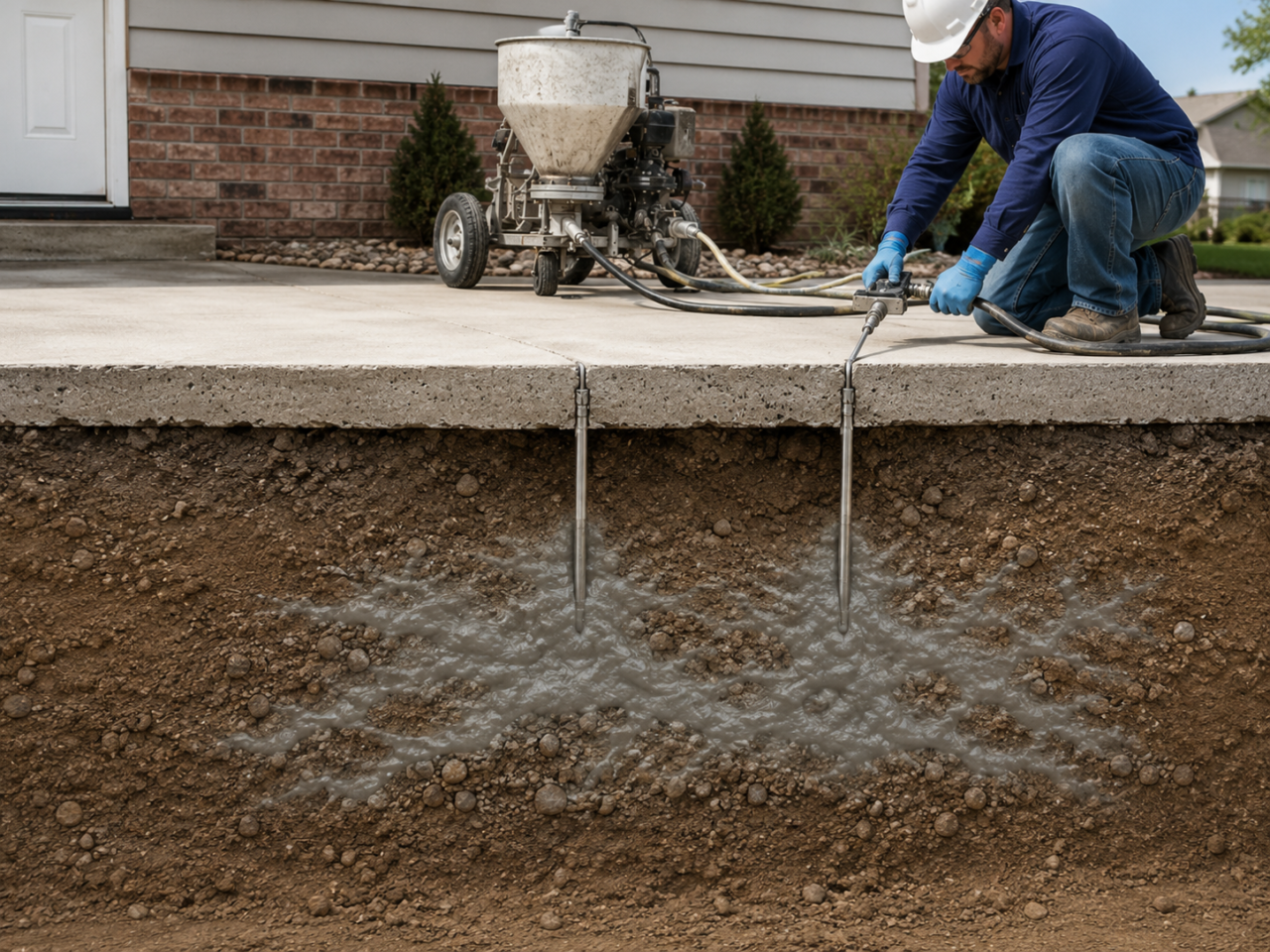
We also specialize in raising and leveling settled concrete using geo-polymer injection. Rather than relying on traditional heavy cement-based material for many slab-lifting applications, our approach uses custom-formulated polymers injected beneath the concrete to fill voids, stabilize underlying areas, and carefully raise slabs back toward the desired elevation. Slabjack Geotechnical has also pioneered dual-hose and multi-polymer slab-lifting techniques designed to provide controlled lifting and effective void filling. This gives us the ability to address both visible concrete settlement and, when necessary, deeper geotechnical conditions contributing to instability.
Get the Right Soil Stabilization Solution From Slabjack Geotechnical
Choosing between permeation grouting vs compaction grouting ultimately comes down to what is happening beneath the surface. Permeation grouting strengthens soil by filling natural pore spaces with flowable grout, while compaction grouting uses stiff grout to displace and densify unstable ground. Both techniques can provide effective soil stabilization when they are matched to appropriate subsurface conditions.
If you are dealing with foundation settlement, unstable soil, erosion, voids, or sinking concrete in Washington or Northern Idaho, get in touch with Slabjack Geotechnical to find out which repair method may be right for your property. Our team can evaluate your project, explain your soil stabilization and concrete repair options, and develop an appropriate solution for the conditions at your site. Contact us today to learn more about our permeation and compaction grouting services or to request a repair estimate.
FAQs
What is the difference between permeation grouting and compaction grouting?
Permeation grouting uses a low-viscosity grout that flows into the pore spaces between soil particles, while compaction grouting uses a stiff grout that displaces and densifies surrounding soil. The best method depends on the soil type, cause of instability, and project goals.
What is permeation grouting used for?
Permeation grouting is commonly used to strengthen granular soils, reduce soil permeability, control groundwater movement, and support foundations or excavations. It works by filling interconnected voids within the soil without significantly displacing it.
What is compaction grouting used for?
Compaction grouting is used to improve the density and load-bearing capacity of loose or unstable soil. It can be especially useful for addressing settlement beneath foundations, slabs, and other structures.
How do I know whether I need permeation grouting or compaction grouting?
The decision should be based on soil composition, settlement patterns, groundwater conditions, structural loads, and the underlying cause of instability. A professional site evaluation can determine which soil stabilization method is best suited to the project.