
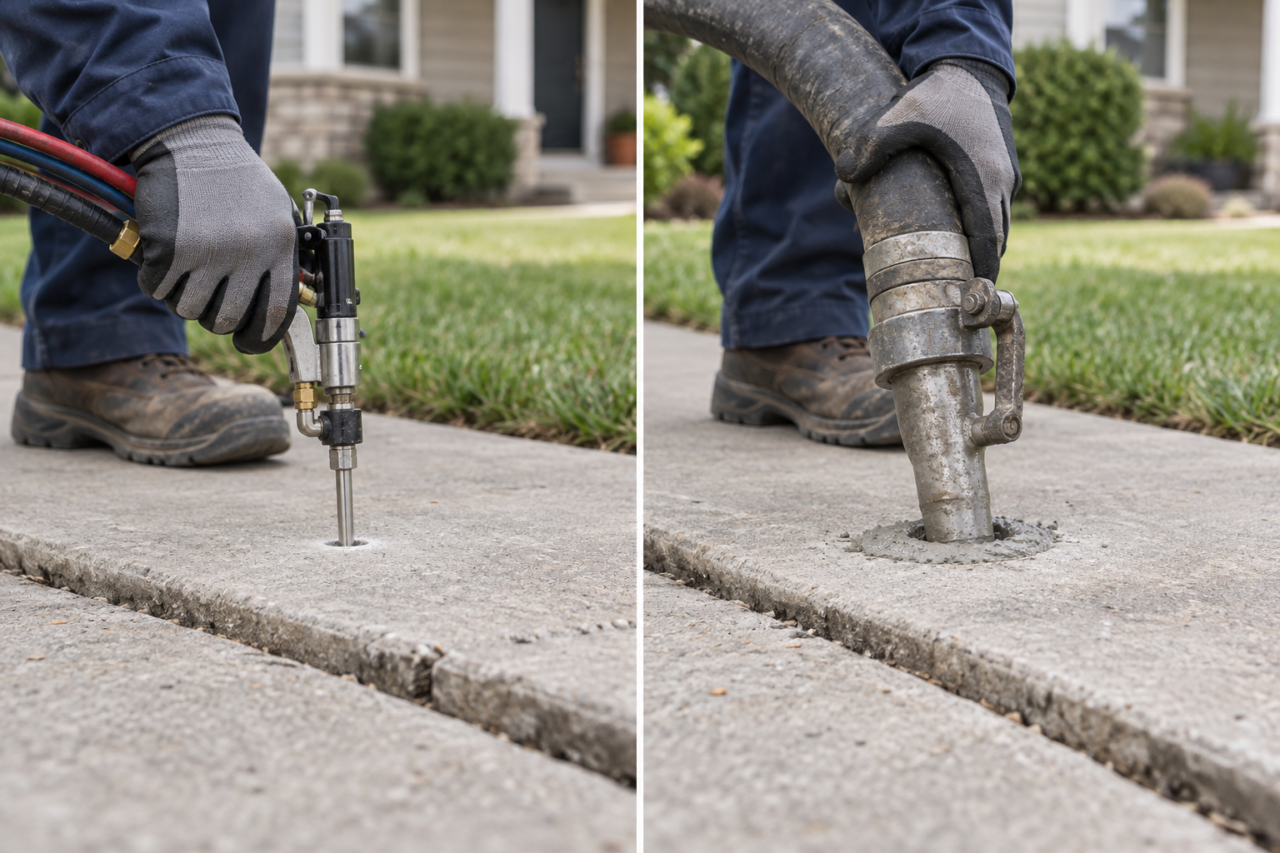
Sunken and uneven concrete can create more than an unattractive surface. Settlement can lead to trip hazards, drainage problems, uneven transitions, and additional stress on concrete slabs. When the concrete itself is still structurally sound, raising and stabilizing the existing slab can often be a more practical alternative to tearing it out and replacing it.
Two common approaches are polyurethane concrete lifting, sometimes called polyjacking or geo-polymer injection, and traditional mudjacking. Although both techniques are designed to raise settled concrete, they differ considerably in the materials used, installation process, added weight, curing time, precision, durability, and overall performance.
When comparing polyurethane vs mudjacking, polyurethane injection generally provides a lighter, faster, and more precise approach to concrete leveling. However, understanding how each method works—and what contributes to their respective costs—can help property owners determine which solution makes the most sense for their concrete repair project.
What Is Polyurethane Concrete Leveling?
Polyurethane concrete leveling involves drilling small injection holes through a settled concrete slab and introducing a specially formulated polymer beneath it. The material expands beneath the concrete, filling voids and generating controlled lifting pressure that can gradually return the slab toward its intended elevation.
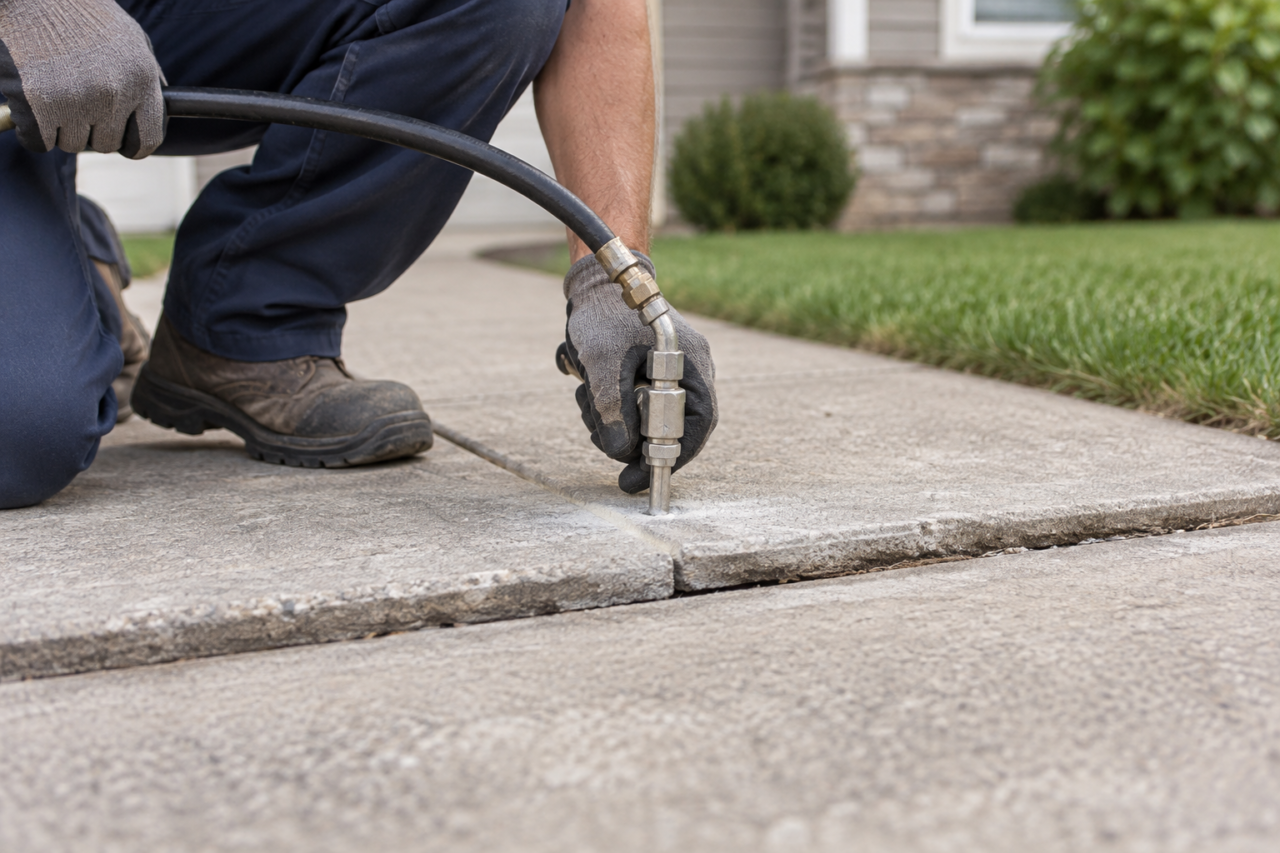
The process is often referred to as polyjacking, polyurethane foam injection, polymer slabjacking, or geo-polymer injection.
One important advantage is the relatively low weight of the injected material. Slabjack Geotechnical, for example, uses a polymer that weighs approximately four pounds per cubic foot, compared with the much heavier slurry traditionally used for mudjacking.
What Is Mudjacking?
Mudjacking is a traditional concrete lifting method in which a dense slurry is pumped beneath a settled concrete slab through drilled holes.
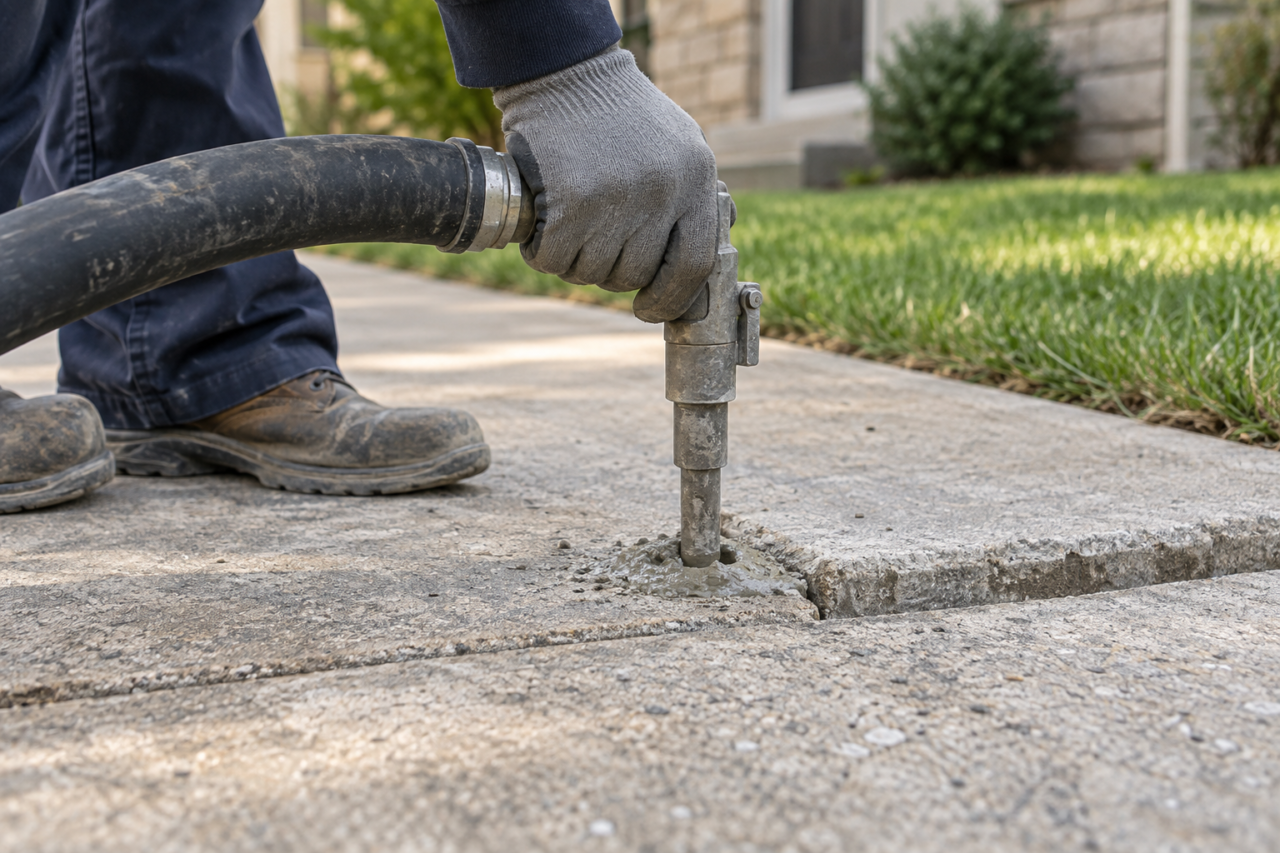
Depending on the contractor and application, the slurry may contain combinations of cement, soil, sand, water, limestone, or other materials. Hydraulic pressure generated by pumping the mixture underneath the slab gradually raises the concrete.
Mudjacking has been used for decades and can still raise certain settled slabs effectively. However, the material is considerably heavier than polyurethane and typically requires larger injection holes.
Polyurethane vs Mudjacking: Side-by-Side Comparison
The fundamental difference between polyurethane vs mudjacking is the material placed beneath the concrete. That distinction affects nearly every other part of the repair, from hole size and added weight to curing time and lifting precision.
| Comparison | Polyurethane / Polyjacking | Mudjacking |
| Injection material | Expanding structural polymer | Cement-, soil-, or sand-based slurry |
| Material weight | Very lightweight | Significantly heavier |
| Injection holes | Small-diameter holes | Typically larger holes |
| Lifting control | Highly controlled incremental lifting | Hydraulic lifting using slurry pressure |
| Void filling | Expanding polymer can spread into underlying voids | Slurry fills accessible spaces beneath slab |
| Curing time | Generally very fast | Usually requires more curing time |
| Site disruption | Minimal | Can require more cleanup |
| Finished appearance | Smaller patched injection points | Larger and potentially more numerous patches |
| Interior applications | Well suited to many interior projects | More difficult because of slurry and cleanup |
| Added soil load | Minimal because polymer is lightweight | Adds substantial material weight beneath slab |
| Moisture resistance | Polymer does not wash away like soil-based material | Performance can be affected by continued soil and water problems |
| Typical objective | Precise lifting, void filling, and stabilization | Traditional slab lifting at potentially lower upfront cost |
The condition beneath the concrete still matters regardless of the repair method. Drainage problems, erosion, poorly compacted fill, expansive soils, or deeper ground instability may need to be addressed for the repair to perform as intended.
Mudjacking vs Polyurethane: How the Installation Processes Differ
The overall concept behind both methods is similar: access the space beneath the slab, inject material, and use that material to raise the concrete.
The actual installation process is quite different.
Polyurethane Injection Process
A typical polyurethane lifting project involves:
- Drilling relatively small holes through the concrete.
- Positioning injection equipment at strategically selected locations.
- Injecting polymer beneath the slab.
- Allowing the material to expand and fill underlying voids.
- Carefully monitoring the elevation of the concrete.
- Making additional injections where necessary.
- Patching the injection holes once lifting is complete.
At Slabjack Geotechnical, the process is summarized as “drill, inject, patch.” The company uses custom-formulated polymers and has developed methods involving dual-hose and multi-polymer applications to improve lifting and void-filling performance.
Traditional Mudjacking Process
Mudjacking generally involves:
- Drilling larger holes into the concrete.
- Pumping a dense slurry beneath the slab.
- Building hydraulic pressure below the concrete.
- Continuing to pump material until the slab reaches the desired elevation.
- Allowing the slurry to set.
- Patching the larger injection holes.
- Cleaning slurry residue from the surrounding area.
Because traditional mudjacking uses a heavier material and larger access holes, the process may create more disruption and cleanup than polyurethane injection.
Which Method Adds Less Weight Beneath the Concrete?
Weight is one of the most important differences when comparing mudjacking vs polyurethane.
Concrete settlement frequently occurs because the underlying soil has consolidated, washed away, contained poorly compacted fill, or otherwise lost the ability to provide uniform support. Adding substantial additional weight to those soils can therefore be a concern.
Slabjack Geotechnical reports that traditional mud or concrete slurry may weigh between approximately 100 and 140 pounds per cubic foot. Its polyurethane material, by comparison, weighs approximately four pounds per cubic foot.
That significant difference means polyurethane can provide lifting and void-filling capabilities without placing nearly as much additional load on already stressed soils.
Polyurethane Requires Smaller Injection Holes
Injection-hole size is another noticeable difference between the two methods.
Mudjacking must move a thick slurry through the concrete and beneath the slab, requiring relatively large access holes. These holes are patched afterward, but the repairs can remain visible.
Polyurethane materials can be injected through much smaller ports. That makes it possible to complete the lifting operation with less disturbance to the slab and smaller patches after the project is finished.
Smaller holes are particularly beneficial on highly visible surfaces such as:
- Decorative patios
- Entryways
- Pool decks
- Finished garage floors
- Commercial walkways
- Interior concrete floors
They can also reduce the amount of concrete removed during the repair process.
Which Concrete Leveling Method Is More Precise?
Polyurethane injection generally provides greater control during the lifting process.
The polymer is introduced incrementally beneath specifically selected areas of the slab. As it expands, technicians can monitor slab movement and adjust injection locations and volumes as needed.
This controlled expansion is particularly helpful when working around:
- Door thresholds
- Garage floors
- Steps and porches
- Drainage slopes
- Adjacent slabs
- Interior floors
- Commercial facilities
- Areas requiring relatively precise elevation changes
Mudjacking can also achieve successful lifts, but manipulating a heavy slurry with hydraulic pressure generally offers less refined control than carefully metered polymer injections.
Polyurethane vs Mudjacking for Void Filling
Concrete settlement is frequently associated with voids beneath the slab. Simply raising the visible surface without adequately addressing those spaces can leave areas of the concrete unsupported.
Polyurethane expands after injection, allowing it to move into accessible voids and create additional support beneath the slab.
This makes polymer injection useful where void formation has resulted from issues such as:
- Soil settlement
- Erosion
- Poorly compacted fill
- Water movement
- Utility trench settlement
- Washout beneath concrete
Slabjack Geotechnical uses geo-polymer injection for both concrete raising and void-filling applications and emphasizes the ability of its polymers to fill underlying spaces while placing very little additional weight on the soils.
Which Method Can Be Used Sooner After Repairs?
One of the biggest practical benefits of polyurethane concrete lifting is fast curing.
Traditional mudjacking relies on a cementitious or soil-based slurry that requires time to set adequately before the concrete is subjected to normal loads.
Polyurethane reacts and cures much more quickly. Many repaired surfaces can be ready for use in approximately 30 minutes following injection.
Fast return to service can be especially valuable for:
- Driveways
- Commercial entrances
- Loading areas
- Warehouses
- Municipal sidewalks
- Industrial facilities
- Busy pedestrian areas
Reducing downtime can sometimes be just as important as reducing repair costs.
Polyurethane vs Mudjacking Durability
When evaluating durability, it is important to separate the lifting material from the underlying reason the slab settled.
Neither polyurethane nor mudjacking can prevent every future settlement problem if significant erosion, drainage problems, or deeper soil instability continues beneath the repaired area.
However, polyurethane offers several characteristics that may provide advantages over traditional mudjacking.
Lightweight Material
Because polyurethane adds relatively little weight beneath the slab, it does not significantly increase the load placed on already compromised soils.
Resistance to Water
Properly cured structural polyurethane does not behave like a soil-based slurry that can soften or erode through continued exposure to water. Slabjack Geotechnical describes its geo-polymer injection system as resistant to washing out or deteriorating over time.
Effective Void Filling
Expansion allows the polymer to fill accessible spaces beneath the slab, helping restore support in areas where material has been lost.
These characteristics can make polyurethane especially attractive for projects where long-term stability and minimal additional soil loading are priorities.
Mudjacking vs Polyurethane Cost
Cost is often one of the first questions property owners have when comparing mudjacking vs polyurethane.
Mudjacking can sometimes have a lower initial price because the materials used in the slurry are inexpensive. Polyurethane materials and specialized injection equipment can result in a higher upfront cost for some projects.
However, price should not be evaluated solely according to the cost of the injected material.
Factors that can influence concrete leveling costs include:
- Total square footage
- Amount of settlement
- Number and size of slabs
- Depth and volume of underlying voids
- Accessibility
- Required lifting height
- Soil conditions
- Interior versus exterior location
- Drainage conditions
- Required stabilization
- Labor and equipment needs
Polyurethane may offer additional value through faster curing, smaller injection holes, reduced cleanup, greater precision, and considerably less weight placed on the underlying soil.
For that reason, property owners should compare the entire repair solution—not simply the initial price per square foot.
When Might Mudjacking Still Make Sense?
Mudjacking is an established concrete lifting technique and may remain an option for certain straightforward exterior projects.
Situations in which a property owner might consider it include projects where:
- Upfront price is the primary consideration.
- The slab is relatively accessible.
- Larger injection holes are not an aesthetic concern.
- Added slurry weight is not considered problematic.
- Downtime is less important.
- The surrounding area can easily accommodate slurry cleanup.
The suitability of any leveling method should ultimately be determined by actual site conditions rather than cost alone.
When Is Polyurethane Injection the Better Choice?
Polyurethane is often the stronger choice when the project requires precise lifting, low added weight, small injection points, fast curing, or effective void filling.
It can be particularly useful when:
- The underlying soils have already struggled to support the slab.
- Minimizing additional weight is important.
- The concrete needs to return to service quickly.
- The slab is located indoors.
- Small repair holes are preferred.
- Significant voids exist beneath the concrete.
- Controlled lifting is required.
- Cleanup and site disruption need to be minimized.
For residential, commercial, municipal, and industrial applications, these advantages have made polymer injection an increasingly attractive alternative to conventional mudjacking.
Professional Geo-Polymer Concrete Repair From Slabjack Geotechnical
At Slabjack Geotechnical, we are a family-owned and operated full-service concrete repair company serving residential, commercial, municipal, and industrial customers throughout Washington and Northern Idaho. Our team specializes in solving concrete settlement, subsurface void, soil stabilization, and related repair problems using methods selected according to the actual conditions of each property.
Our concrete repair services and geotechnical capabilities include Slabjacking (concrete raising), pressure grouting, compaction and permeation grouting, concrete grinding, joint sealing repair, crack repair, and void filling. We also provide specialized services for sealing leaking culverts, large-diameter pipes, and concrete ditches.
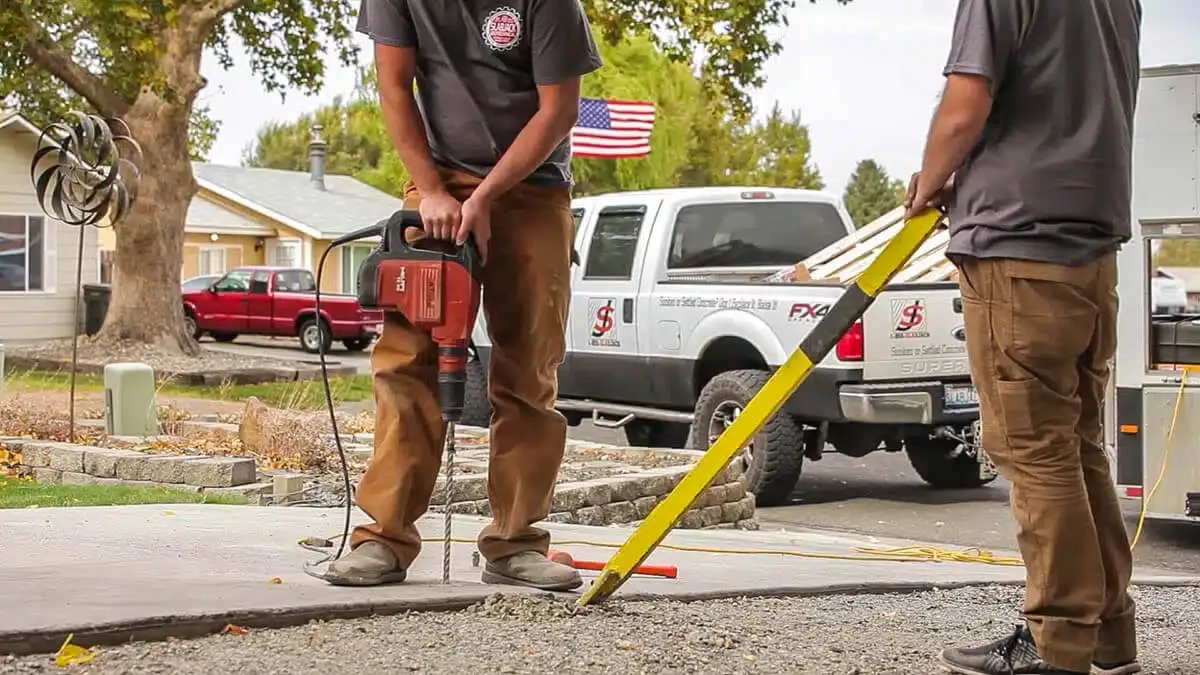
For concrete lifting applications, we have invested extensively in the geo-polymer injection method rather than relying on traditional mudjacking. We use custom-formulated polymers and specialized injection techniques designed to produce controlled lifts, fill underlying voids, minimize additional weight on compromised soils, and reduce disruption to the surrounding property. Our team has successfully completed thousands of lifts and continues to use polymer technology for projects ranging from residential slabs to large commercial and geotechnical applications.
Get a Professional Concrete Leveling Estimate From Slabjack Geotechnical
Choosing between mudjacking vs polyurethane ultimately comes down to more than simply raising a piece of concrete. The right repair should account for why the slab settled, what is happening beneath it, how much additional weight the ground can support, and what method can deliver the most reliable long-term result.
At Slabjack Geotechnical, our geo-polymer injection approach allows us to precisely raise settled concrete while filling underlying voids and minimizing additional load on the surrounding soil. Whether you have an uneven driveway, sinking sidewalk, settled patio, garage floor, commercial slab, or a more complex geotechnical problem, our team can evaluate the conditions and recommend an appropriate repair strategy.
Contact Slabjack Geotechnical today to learn more about geo-polymer concrete leveling or request a repair estimate for your property in Washington or Northern Idaho.
FAQs
What is the difference between polyurethane vs mudjacking?
The main difference between polyurethane vs mudjacking is the material used to lift the concrete. Polyurethane leveling uses a lightweight expanding polymer, while mudjacking uses a heavier cement-, sand-, or soil-based slurry pumped beneath the slab.
Is polyurethane better than mudjacking for concrete leveling?
Polyurethane is often preferred because it requires smaller injection holes, cures quickly, adds less weight to the soil, and allows for precise lifting. Mudjacking can still be effective for certain projects, especially where upfront cost is a primary concern.
When is mudjacking a good option?
Mudjacking may be suitable for straightforward exterior concrete leveling projects where larger injection holes and additional material weight are not major concerns. It can also appeal to property owners who prioritize lower initial repair costs.
When is polyurethane concrete leveling the better choice?
Polyurethane is often the better choice when a project requires precise lifting, fast curing, lightweight material, small injection holes, or effective void filling. It can be especially useful where minimizing additional pressure on weak soils is important.