
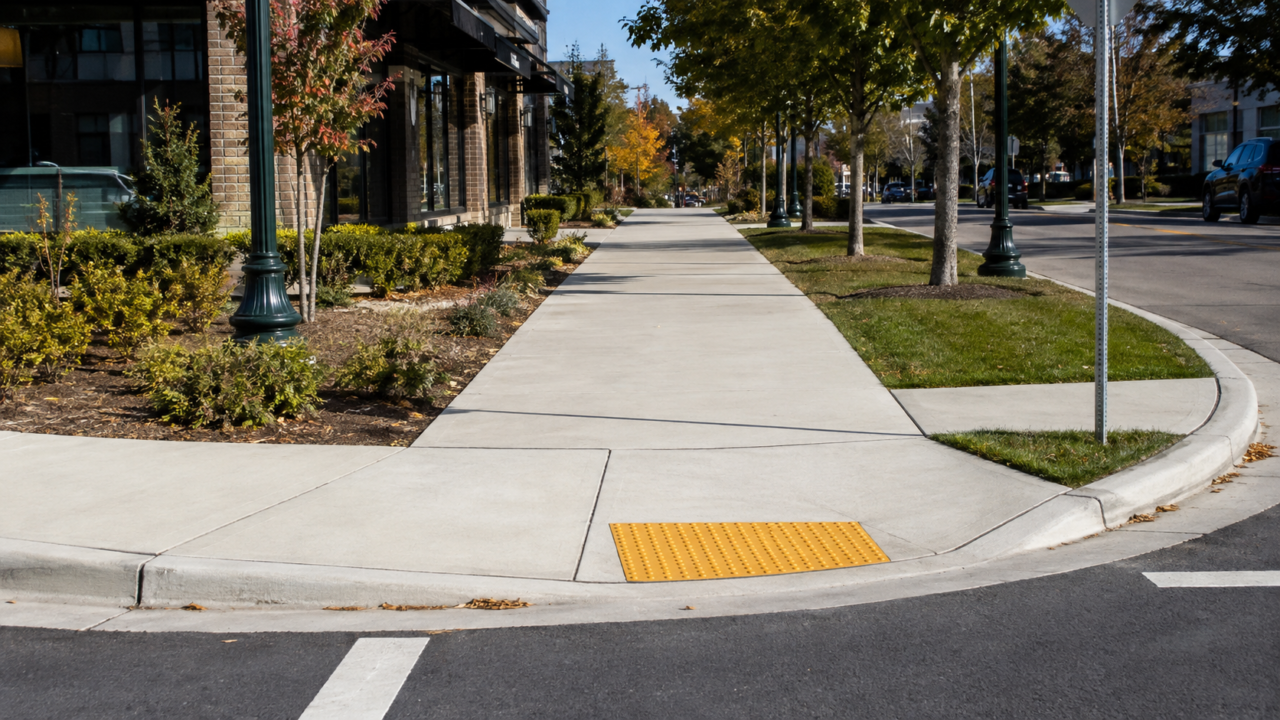
Sidewalk accessibility is more than a matter of convenience. For businesses, commercial property owners, municipalities, and other organizations that serve the public, maintaining accessible pedestrian routes can be an important part of providing safe and usable access to a property.
An ADA compliant sidewalk should allow people with mobility disabilities to move between parking areas, public sidewalks, building entrances, and other accessible areas without encountering unnecessary barriers. Federal accessibility standards address features such as sidewalk width, slope, surface condition, changes in elevation, ramps, and clear travel paths. Businesses open to the public must also follow accessibility requirements when constructing or altering facilities, while existing facilities can have an ongoing obligation to remove architectural barriers when doing so is readily achievable.
For property owners in Washington and Northern Idaho, however, understanding ADA compliant sidewalk requirements requires another important distinction. Private walkways and accessible routes generally fall under federal ADA standards, while sidewalks within public rights-of-way may also be subject to state transportation requirements and local city or county standards.
Here is what property owners should understand when evaluating sidewalks and determining when concrete repairs may be necessary.
What Is an ADA Compliant Sidewalk?
An ADA compliant sidewalk is a pedestrian route designed and maintained so people with disabilities can travel along it safely and independently.
The 2010 ADA Standards establish accessibility requirements for newly constructed and altered public accommodations, commercial facilities, and state or local government facilities. Accessible routes can include sidewalks and other walking surfaces connecting accessible parking, passenger loading zones, public streets and sidewalks, transportation stops, and accessible entrances.
An accessible sidewalk generally needs to provide:
- Adequate clear width for pedestrian travel
- A firm, stable, and slip-resistant surface
- Acceptable running and cross slopes
- Limited vertical changes between concrete panels
- Accessible curb ramps where required
- A continuous path without obstacles that reduce required clearance
- Proper transitions between sidewalks, parking areas, entrances, and other accessible spaces
Concrete settlement can interfere with several of these conditions at the same time. One sunken sidewalk panel, for example, may create both a vertical trip hazard and an excessive slope.
Key ADA Compliant Sidewalk Requirements
Although the exact requirements depend on where the sidewalk is located and which regulations apply, several federal accessibility specifications are especially important for commercial property owners.
1. Sidewalk and Accessible Route Width
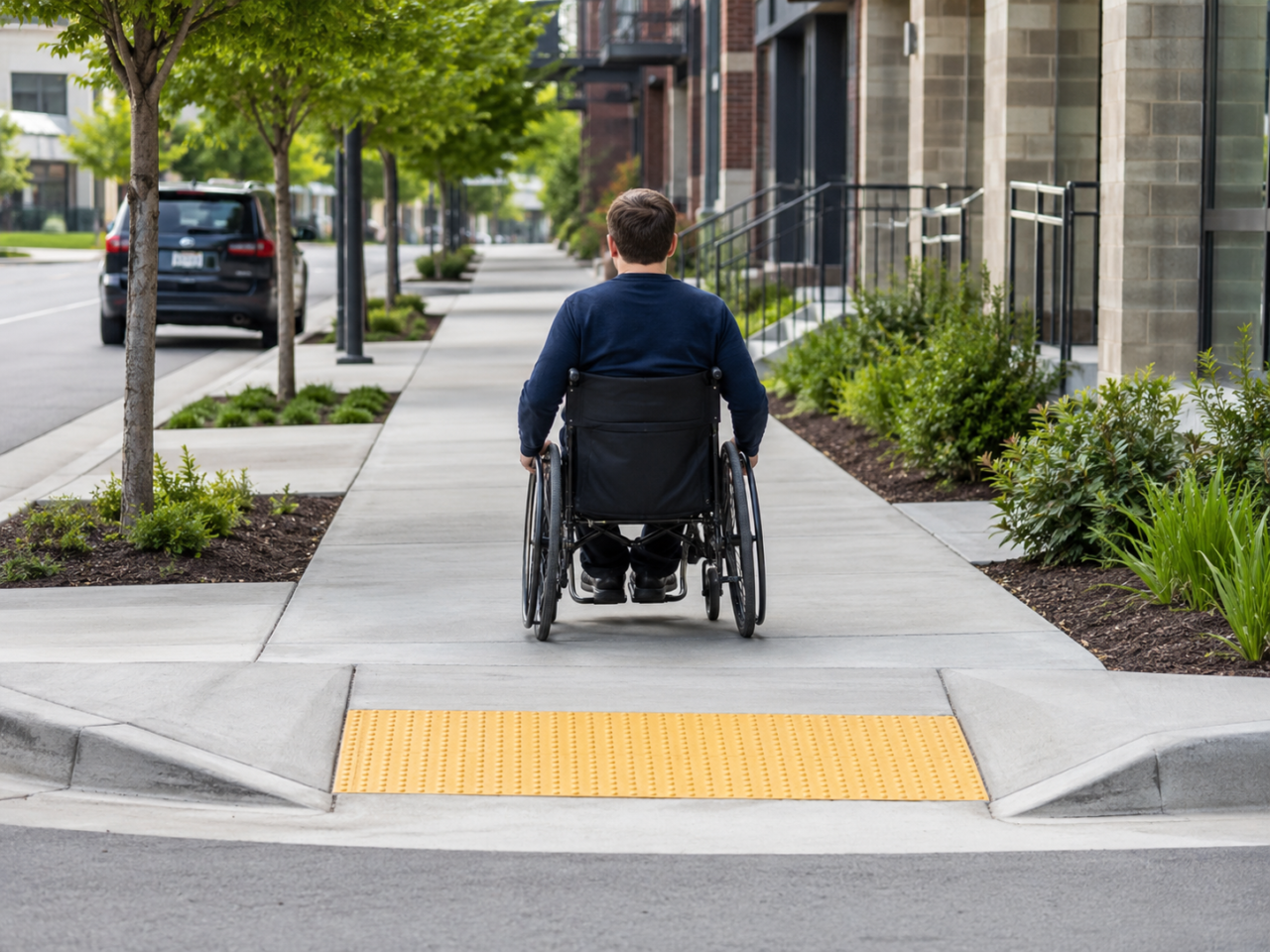
Under the ADA Standards, walking surfaces on an accessible route generally must provide at least 36 inches of continuous clear width, with limited exceptions for short, narrow segments. Additional space can be required for passing and maneuvering in certain configurations.
That does not mean every sidewalk in Washington or Idaho can simply be designed to a 36-inch minimum.
Public-right-of-way standards can be wider. For example, current WSDOT policy calls for a pedestrian access route at least 5 feet wide on facilities to which its policy applies.
Because municipal requirements can differ, property owners should verify the standards adopted by the city, county, transportation agency, or other authority having jurisdiction before beginning sidewalk construction or alteration.
2. Running Slope
For a walking surface forming part of an accessible route under the ADA Standards, the running slope generally cannot be steeper than 1:20, or 5%. A route that becomes steeper than 1:20 is treated as a ramp and becomes subject to additional ramp requirements.
A sidewalk that has settled unevenly can develop a localized slope significantly steeper than originally constructed. That can make the route difficult for wheelchair users and people using walkers, canes, or other mobility aids.
For property owners, visible settlement should therefore be evaluated rather than viewed only as a cosmetic concrete problem.
3. Cross Slope
Cross slope measures the slope across the direction of pedestrian travel.
Under the ADA Standards, the cross slope of an accessible walking surface generally cannot be steeper than 1:48, which is approximately 2.08%.
Excessive cross slope can cause a wheelchair or mobility device to pull toward one side of the route. It can also make walking more challenging for someone with limited balance or mobility.
Settlement along one edge of a sidewalk is a common reason an originally acceptable cross slope may become problematic over time.
4. Changes in Level Between Concrete Panels
One of the most important ADA compliant sidewalk requirements for existing concrete involves vertical changes between adjacent surfaces.
Under the ADA Standards:
- Vertical changes in level of up to 1/4 inch can generally remain vertical.
- Changes between 1/4 inch and 1/2 inch must generally be beveled with a slope no steeper than 1:2.
- Larger elevation changes cannot simply remain as abrupt vertical offsets and generally must be addressed through an accessible slope, ramp, or other compliant transition as applicable.
These requirements make displaced sidewalk panels especially important for property owners to monitor.
Tree roots, erosion, poorly compacted fill, water movement, freeze-thaw cycles, and soil settlement can cause neighboring slabs to move independently. Even relatively small movements can eventually create an accessibility problem.
5. Sidewalk Surfaces Must Be Firm, Stable, and Slip Resistant
Accessible routes must have surfaces that are firm, stable, and slip resistant.
For concrete sidewalks, property owners should watch for conditions such as:
- Severe cracking
- Broken or deteriorated slabs
- Loose material
- Spalling
- Significant settlement
- Raised edges
- Large gaps or openings
- Areas where erosion has undermined the slab
Not every cosmetic crack automatically makes a sidewalk inaccessible. The more important question is whether deterioration affects the stability, continuity, elevation, or usability of the accessible route.
6. Curb Ramp Requirements
Where an accessible pedestrian route transitions between a sidewalk and street level, curb ramps can be a critical accessibility feature.
Under ADA ramp requirements, a typical ramp’s running slope generally cannot exceed 1:12, or approximately 8.33%, and its cross slope generally cannot exceed 1:48. Curb ramps and their adjoining landings must also satisfy additional dimensional and design requirements.
Public-right-of-way curb ramps may have additional requirements involving detectable warning surfaces, landings, clear space, alignment, drainage, and connections to pedestrian routes.
Property owners should not assume that simply pouring a sloped section of concrete creates an ADA compliant curb ramp. The entire transition needs to be evaluated against the standards that apply to the location.
ADA Compliant Sidewalk Requirements in Washington
Washington property owners should distinguish between sidewalks located entirely on private commercial property and pedestrian facilities located within a public right-of-way.
For private commercial facilities and public accommodations, the federal ADA Standards establish the baseline requirements for accessible routes when applicable.
Within Washington public rights-of-way, additional transportation and local standards can apply. WSDOT’s accessibility policies and design guidance address pedestrian access routes, sidewalks, curb ramps, crossings, and related facilities. Current WSDOT policy specifies a minimum 5-foot pedestrian access route, a maximum 5% running slope except where curb-ramp provisions apply, and a maximum 2% cross slope for facilities covered by that policy.
WSDOT also cautions that its Design Manual was developed for state transportation facilities and may not necessarily be appropriate for every county road or city street.
That distinction is important. A commercial sidewalk in Seattle, Spokane, Tacoma, Wenatchee, the Tri-Cities, or another Washington community may also be affected by local municipal codes, permit requirements, frontage-improvement standards, or public works specifications.
Property owners should confirm local requirements before reconstructing or substantially altering a sidewalk.
ADA Compliant Sidewalk Requirements in Northern Idaho
The same general principle applies in Northern Idaho.
Federal ADA requirements establish accessibility obligations for covered facilities, but public sidewalks can also be governed by Idaho Transportation Department specifications and individual municipal requirements.
Current ITD standard drawings for projects to which they apply require at least 4 feet of continuous clear width for the pedestrian access route, excluding the curb. When the route is less than 5 feet wide, 5-foot-by-5-foot passing spaces are required at intervals of 200 feet or less. ITD standards also address cross slope and vertical surface discontinuities.
ITD maintains its standards specifically for department and applicable Federal-Aid projects, so a sidewalk in Coeur d’Alene, Post Falls, Hayden, Sandpoint, or another Northern Idaho community may have additional local design requirements.
Before modifying a sidewalk located in or adjacent to a public right-of-way, owners should determine who controls the sidewalk and which permits or construction standards apply.
How Can Uneven Concrete Sidewalks Be Repaired?
The right repair depends on why the concrete moved, how severely it is damaged, and how much elevation correction is needed.
Concrete Raising or Slabjacking
When the concrete itself remains structurally serviceable but has settled, raising the existing slab may restore the elevation and improve the transition between sidewalk panels.
Modern geo-polymer injection can be particularly useful in these situations. Expanding material is injected through small access points beneath the concrete, where it fills voids, stabilizes weak supporting areas, and can precisely lift a settled slab.
This approach can reduce the demolition and disruption associated with complete sidewalk replacement.
Concrete Grinding
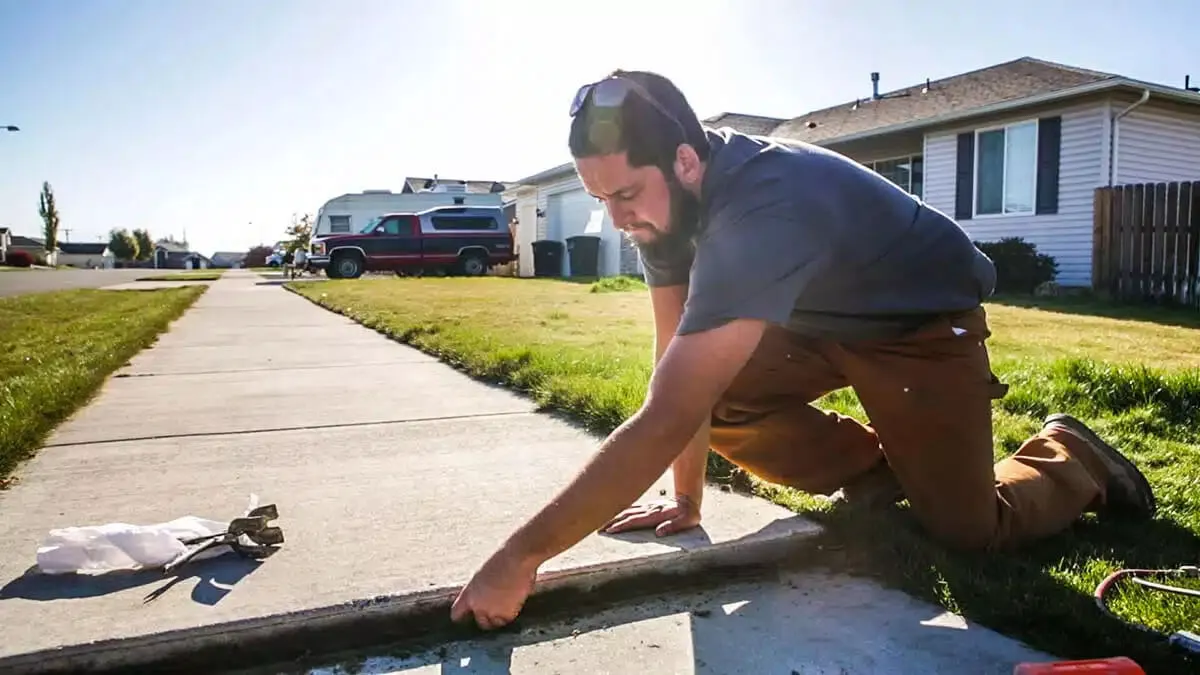
Where an elevation difference is relatively small and the surrounding concrete is otherwise sound, concrete grinding may be appropriate for correcting certain raised edges and creating a smoother transition.
Whether grinding can produce a compliant finished surface depends on the amount of displacement, slab thickness, resulting slope, and overall sidewalk condition.
Crack and Joint Repair
Cracks and failed joints can allow water to penetrate beneath concrete, potentially contributing to erosion and continued settlement.
Sealing appropriate cracks and joints can therefore be part of a larger sidewalk maintenance strategy. If the slab has already moved, however, correcting the underlying settlement should generally come before simply sealing the visible crack.
Void Filling and Soil Stabilization
Sometimes an uneven sidewalk is only the visible symptom of a larger problem beneath the concrete.
Voids, washout, weak soils, or poorly compacted material can remove support from beneath the slab. Filling these voids and stabilizing the supporting material can help address the cause rather than repairing only the surface.
A Practical ADA Compliant Sidewalk Checklist for Property Owners
When reviewing sidewalks around a commercial property, ask the following questions:
- Is there a continuous accessible route from accessible parking and the public sidewalk to an accessible entrance?
- Is the walking surface firm, stable, and slip resistant?
- Is there adequate clear width throughout the route?
- Are any sidewalk panels vertically displaced?
- Are changes greater than 1/4 inch properly treated?
- Has one side of the sidewalk settled enough to create excessive cross slope?
- Are walking surfaces steeper than 5% where they are not designed as ramps?
- Are curb ramps and transitions intact?
- Have cracks or failed joints allowed water beneath the concrete?
- Are there visible voids or signs of soil erosion?
- Do local city, county, WSDOT, or ITD standards impose additional requirements?
Measurements should be taken carefully rather than estimated visually. For projects involving construction, alteration, or public-right-of-way work, property owners should also verify requirements with the appropriate design professional or local authority.
How Slabjack Geotechnical Can Help Repair Uneven Sidewalks
At Slabjack Geotechnical, we are a family-owned and operated full-service concrete repair company serving Washington and Northern Idaho. We work with residential, commercial, municipal, and industrial properties to address settled concrete, unstable soils, voids, cracks, deteriorated joints, and other conditions that can affect concrete performance. Our company has served the region since 2011 and operates from locations throughout Washington.
Our services include Slabjacking (concrete raising), pressure grouting, compaction and permeation grouting, concrete grinding, joint sealing repair, crack repair, and void filling. We also seal leaking culverts, large-diameter pipes, and concrete ditches. This range of capabilities allows us to evaluate more than the visible surface of a concrete problem and recommend a trip hazard repair method appropriate for the conditions beneath and around the slab.
One of the methods we emphasize is geo-polymer injection. For many settled-concrete applications, lightweight expanding material can be injected beneath the slab through small access points. The material expands to fill voids and improve support while controlled injection can lift the concrete toward the required elevation. Because the process addresses conditions below the slab as well as the surface elevation, it can be an effective option for sidewalks affected by settlement or loss of subgrade support.
Restore Safer, More Accessible Concrete With Slabjack Geotechnical
Maintaining ADA compliant sidewalks begins with understanding how width, slope, surface condition, elevation changes, and accessible connections affect pedestrian travel. It also means recognizing that sidewalk standards can differ depending on whether the route is located on private property, within a Washington or Idaho public right-of-way, or under a specific local jurisdiction.
If your property’s sidewalks have sunken panels, uneven joints, excessive slopes, cracks, or voids underneath the concrete, addressing the problem early may allow you to restore the existing slab instead of replacing it completely.
Contact Slabjack Geotechnical today to learn how our concrete raising, geo-polymer injection, grinding, grouting, crack repair, joint sealing, and void-filling services can help improve the safety and accessibility of your property or to request a concrete repair estimate.
Accessibility requirements depend on the type of facility, project scope, ownership, and jurisdiction. This guide provides a general overview and is not a substitute for project-specific engineering, architectural, permitting, or legal guidance. Always verify applicable federal, state, and local requirements before construction or alteration.
FAQs
What makes a sidewalk ADA compliant?
An ADA compliant sidewalk provides an accessible pedestrian route that people with disabilities can use safely and independently. Important factors can include clear width, slope, surface stability, changes in level, curb ramps, and freedom from obstructions.
How wide does an ADA compliant sidewalk need to be?
ADA accessible routes generally require at least 36 inches of clear width, although wider requirements may apply depending on the location and governing jurisdiction. Public sidewalks may also be subject to state, city, county, or transportation-agency standards.
What is the maximum slope for an ADA compliant sidewalk?
Accessible walking surfaces generally cannot have a running slope steeper than 1:20, or 5%, unless the route is designed and treated as a ramp. Cross slope is generally limited to 1:48, which is approximately 2.08%.
Are uneven sidewalks an ADA compliance issue?
Uneven sidewalks can create an accessibility issue when settlement or raised edges produce excessive changes in level, steep slopes, or difficult transitions. Even relatively small elevation differences can interfere with wheelchair travel or create hazards for people with limited mobility.